

Introduction
Dental growth used to be simple. You treated patients well, did honest work, and over time your clinic grew through referrals. One patient told another. Families stayed loyal for decades. Reputation spread slowly, but it spread deeply.
That model worked for years. In some markets, it worked for generations. But the reality today is very different.
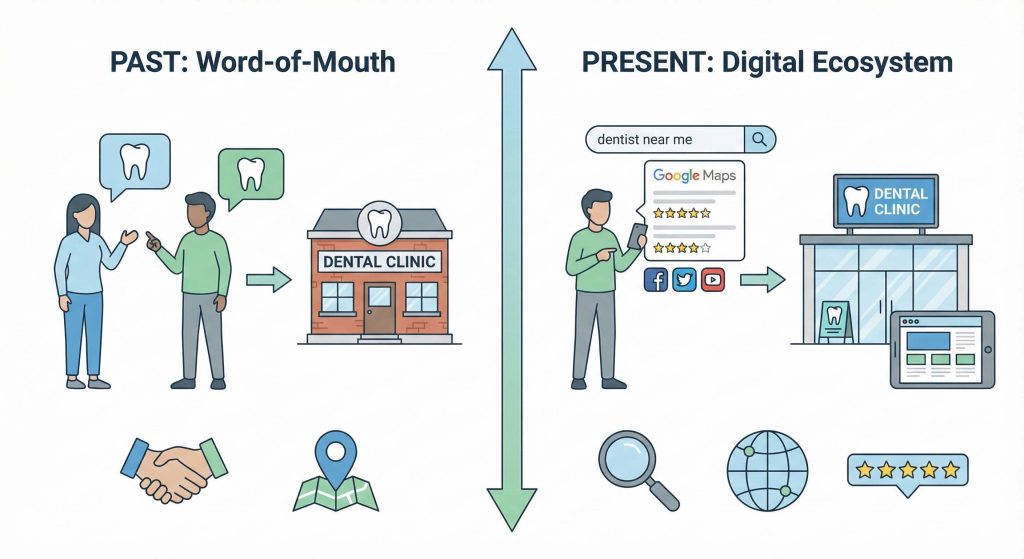
Over the last decade and especially in the last three to five years dental growth has fundamentally shifted. Patients no longer discover clinics primarily through personal recommendations. They discover them through search results, map listings, reviews, websites, social media, and ads. Often without ever speaking to another human being.
The first interaction with your clinic now happens online. Quietly. Invisibly. And usually without your knowledge. A patient searches. Compares. Judges. Filters. And decides. All before calling or booking.
This article explains how dental growth has evolved from word-of-mouth to digital systems, what has changed in patient behavior, and what modern clinics must understand to grow sustainably in today’s environment.
How Dental Clinics Used to Grow
Word-of-mouth wasn’t just a channel. It was the system. Patients chose dentists based on trust transferred from someone they already trusted: a family member, a colleague, or a neighbor.
This created a few important dynamics:
- Growth was slow but stable.
- Competition was local and limited.
- Marketing effort was minimal.
- The clinic itself was the marketing.
In this environment, quality of care mattered most. Branding barely existed. Visibility beyond your immediate neighborhood wasn’t necessary. You didn’t need to explain who you were online because patients arrived pre-sold.
Why Word-of-Mouth Stopped Being Enough
Word-of-mouth didn’t fail because it stopped working. It failed because it stopped scaling.
Several things changed at once. Urban density increased. Competition exploded. Patients moved cities more frequently. Families became less loyal to a single provider. Insurance networks expanded. Corporate dental groups entered the market.
At the same time, digital behavior quietly replaced human behavior. Patients stopped asking people. They started searching. They didn’t trust a single recommendation; they trusted patterns ratings, volume of reviews, and consistency across platforms.
Word-of-mouth still exists, but now it acts as a trigger, not a decision. A friend says, “I went to this dentist.” The patient doesn’t call the clinic. They Google it. That Google search is where growth is now won or lost.
The Modern Dental Patient Journey
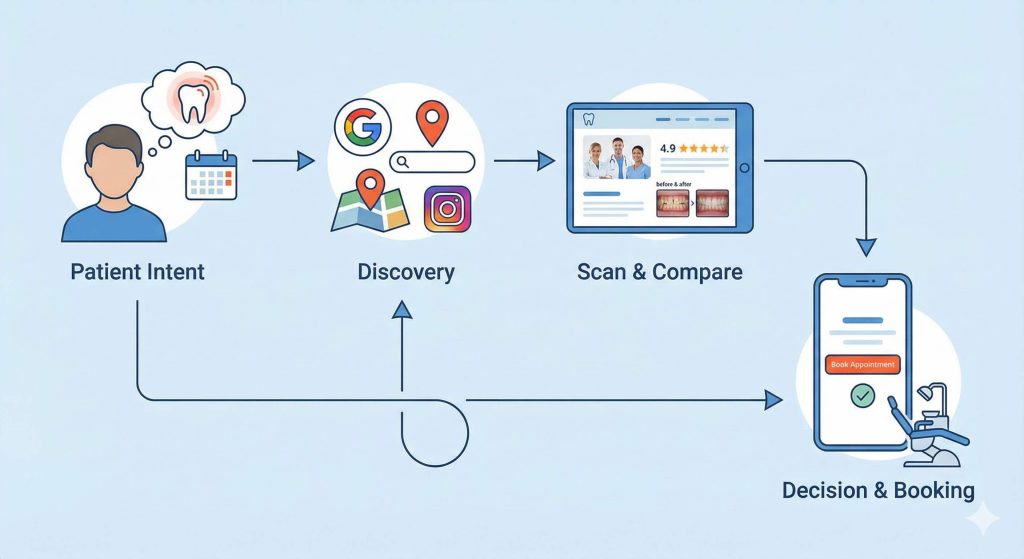
Today’s patient journey looks nothing like the old one. It is non-linear and data-heavy.
- Intent: Pain, discomfort, cosmetic interest, or routine check-up.
- Discovery: Google search, Maps, Instagram, or Ads.
- Scan: The patient scans for signals professionalism, visuals, reviews.
- Decision: Booking (or bouncing).
This is where most clinics lose patients without realizing it. They assume growth happens at the chair. In reality, it happens before the click.
Perception Replaced Proximity
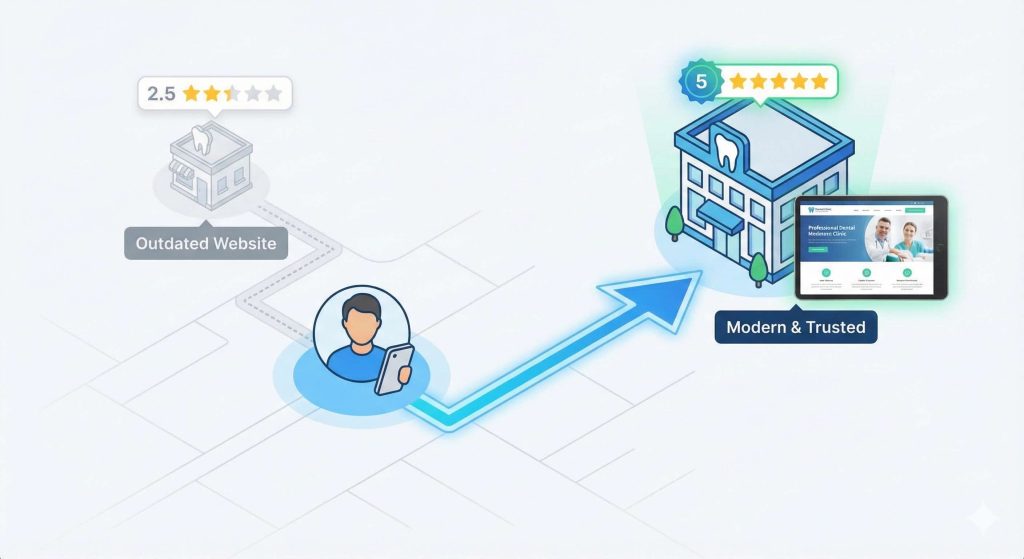
In the past, the closest dentist often won. Today, perception matters more than distance. Patients will drive further, pay more, and wait longer if they feel confident.
Confidence comes from consistency:
- Clear messaging
- Recent, detailed reviews
- Modern visual identity
- Transparent pricing signals
Two clinics can offer identical treatments. The one that appears more credible online wins. This is not about manipulation; it’s about reassurance. Dental decisions are emotional fear, trust, and anxiety play huge roles. Your digital presence either reduces that anxiety or increases it.
Why Visibility Became the New Currency
If your clinic does not appear when patients search, it effectively does not exist in their decision set. Local search results, map listings, and review platforms now act as gatekeepers.
This creates a harsh reality: The best dentist is not always the busiest dentist. The busiest dentist is often the most visible one. Clinics that understand this build systems to control visibility. Clinics that don’t rely on chance.
The Rise of Comparison-Based Decision Making
Patients rarely choose a clinic in isolation. They compare three to five options. They aren’t analyzing your clinical expertise (they can’t). They are evaluating risk.
- Who feels safer?
- Who feels more professional?
- Who feels more established?
Generic websites and outdated listings silently kill growth because they introduce doubt.
Why Digital Trust Signals Matter More Than Claims
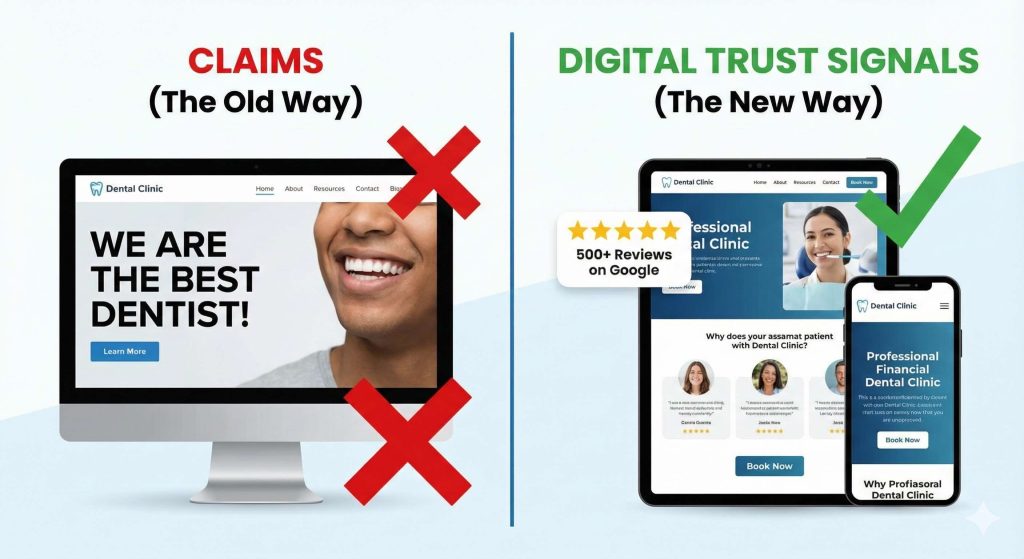
Claims don’t build trust. Signals do. Anyone can say they’re the best. Patients don’t believe that. They believe patterns: hundreds of recent reviews, consistent branding, and active presence. Digital trust is cumulative. It’s built across touchpoints.
The Shift From “Marketing” to “Systems”
Old marketing was promotional. New growth is operational. It’s not about running an ad. It’s about aligning your digital presence with patient psychology.
A Growth System includes:
- Search Appearance: How you show up on Maps.
- Service Clarity: How simply you explain treatments.
- Frictionless Booking: How easy it is to become a patient.
- Reputation Management: How reviews are generated and replied to.
- Retention Loops: How you handle follow-ups and recare.
Growth is no longer a campaign. It’s infrastructure.
Why Branding Matters More Than Ever
Branding used to be considered cosmetic. Now it’s functional. Branding sets expectations. It signals professionalism. It creates familiarity before the first visit. A strong dental brand makes patients feel they’re in capable hands before treatment begins.
What Sustainable Dental Growth Looks Like Today
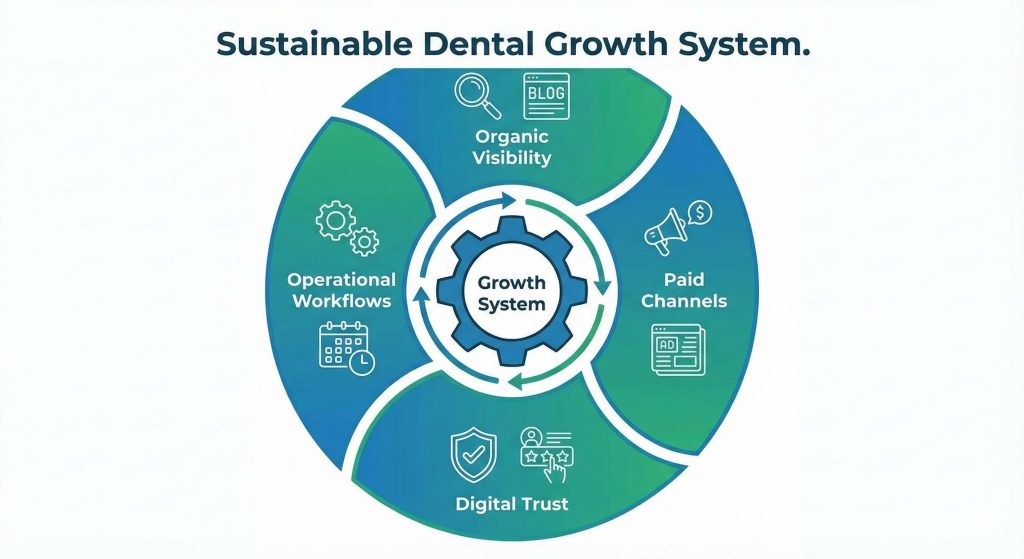
Sustainable growth is predictable. It’s not dependent on one channel, one person, or one campaign. It is a balanced ecosystem.
- Organic visibility captures long-term demand.
- Paid channels provide controlled volume.
- Strong digital trust converts traffic into bookings.
- Operational workflows retain patients for life.
The Role Northstone Insights Plays
At Northstone Insights, we don’t see dental growth as marketing alone. We see it as a patient decision system. Every touchpoint either increases confidence or introduces doubt. Our role is to help clinics align reality with perception, and perception with growth. Not through noise. Through structure.
The Bottom Line
Dental growth didn’t become harder. It became different. Word-of-mouth didn’t disappear. It evolved. Today, trust is built digitally before it’s earned clinically. The clinics that win are the ones that remove friction, build conviction, and understand that growth is a system, not a tactic.

Leave a Comment