

Introduction
Marketing has never been more measurable, yet building a coherent marketing analytics strategy feels harder than it did ten years ago. Every interaction can be tracked, attributed, visualized, and reported, but inside many organizations, clarity is missing.
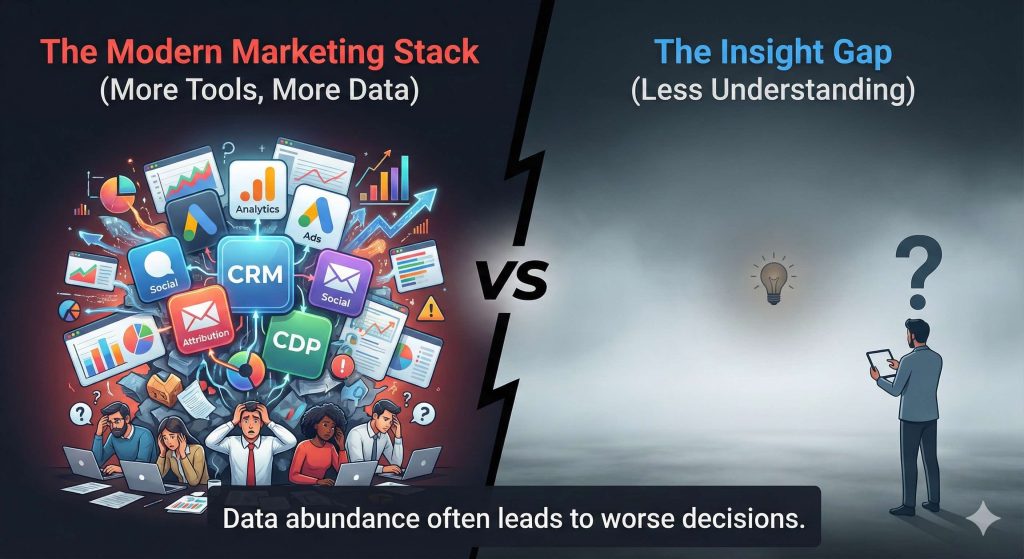
Campaign reviews stretch longer. Performance discussions end without conclusions. Leadership asks for clarity and receives dashboards instead. Teams are busy, budgets are growing, but confidence is shrinking.
This contradiction sits at the heart of modern marketing.
More tools.
More data.
Less insight.
Over the past few years, we’ve worked closely with SaaS companies, healthcare groups, e-commerce brands, and service businesses across the GCC, US, and Europe. The pattern is remarkably consistent. Marketing teams don’t lack intelligence or effort. They lack a system that converts information into understanding.
This paper explains how marketing stacks quietly become bloated, why data abundance often leads to worse decisions, and how high-performing teams rebuild clarity in their marketing analytics strategy without ripping everything apart.
The Tool Explosion Nobody Planned For
Marketing stacks didn’t become complex overnight. They evolved gradually, one reasonable decision at a time.The Core Problem: Tool Overload vs. Insight Gap
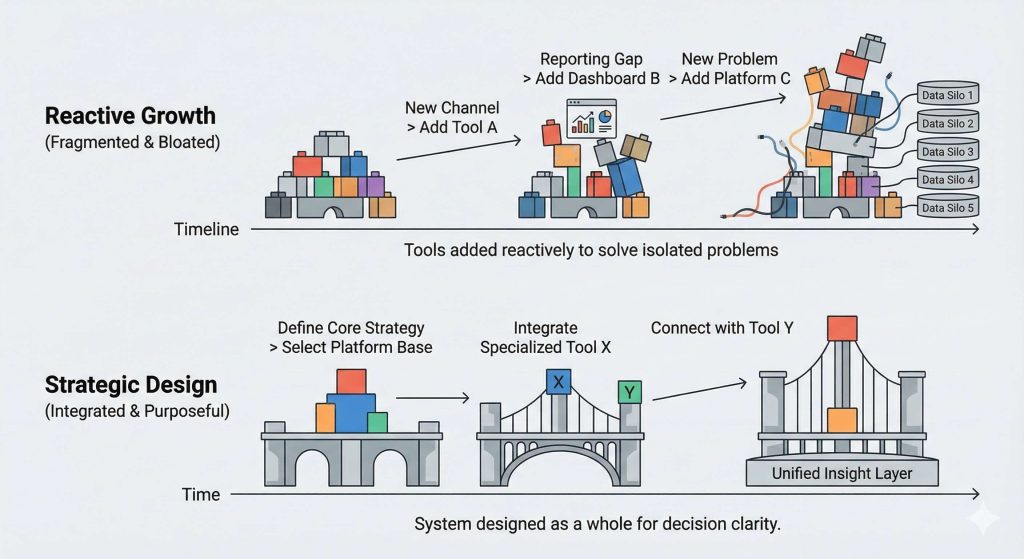
A company starts with basic analytics to understand traffic. As leads grow, a CRM becomes necessary. Email marketing follows. Then automation. Then paid media platforms. Then attribution tools. Then personalization software. Then customer data platforms promising a “single source of truth.”
Each addition solves a real problem in isolation.
The issue is that most teams never design the system as a whole.
Tools are added reactively. A new channel underperforms, so software is introduced to diagnose it. A reporting gap appears, so another dashboard fills the void. Over time, your marketing analytics strategy grows horizontally rather than strategically. What looks like maturity from the outside is often fragmentation underneath.
What looks like maturity from the outside is often fragmentation underneath.
When Measurement Becomes a Substitute for Thinking
Early-stage marketing teams rely heavily on judgment. Decisions are imperfect, but they’re fast. As organizations scale, measurement increases and that’s healthy. The problem begins when measurement replaces reasoning instead of supporting it.
Metrics become the conversation rather than the input.
Teams debate which numbers are “right” instead of what they mean. Weekly reports become ceremonial. Charts multiply. Insight stagnates.
In practice, what actually happens is this:
The more data teams have, the more hesitant they become. Every decision feels risky because another dashboard might contradict it. Instead of enabling action, data becomes a brake.
This is one of the least discussed side effects of modern marketing technology.
The Illusion of Control Created by Dashboards
Dashboards are supposed to simplify reality. Often, they do the opposite.
Most dashboards answer descriptive questions. They tell you what happened. They rarely explain why it happened or what to do next. Yet because they look sophisticated, they create a false sense of control. Leadership sees activity. Teams feel productive. But the core marketing analytics strategy doesn’t advance.
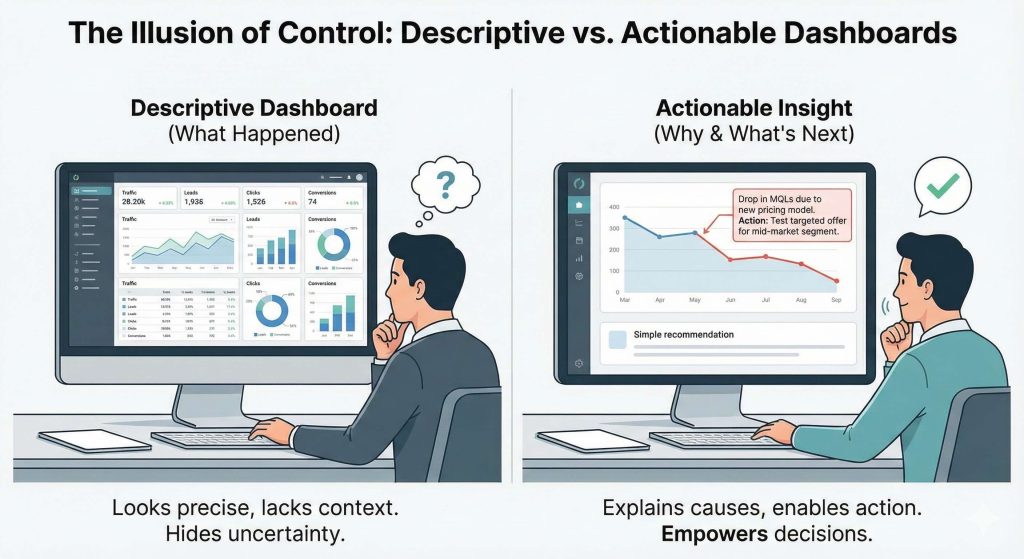
Leadership sees activity. Teams feel productive. But strategy doesn’t advance.
In our experience, the most dangerous dashboards are the cleanest ones. They hide uncertainty behind polished visuals. They reduce complex human behavior into neat graphs that feel precise but lack context.
When insight is missing, dashboards don’t expose the problem. They mask it.
Attribution: The Most Misunderstood Promise in Marketing
Attribution tools are often introduced with high expectations. Finally, teams believe, we’ll know what really drives revenue.
Instead, many organizations discover something unsettling. Different tools produce different answers to the same question. Paid media platforms over-credit themselves. Analytics tools undercount. CRM systems lag behind reality. Attribution models conflict.
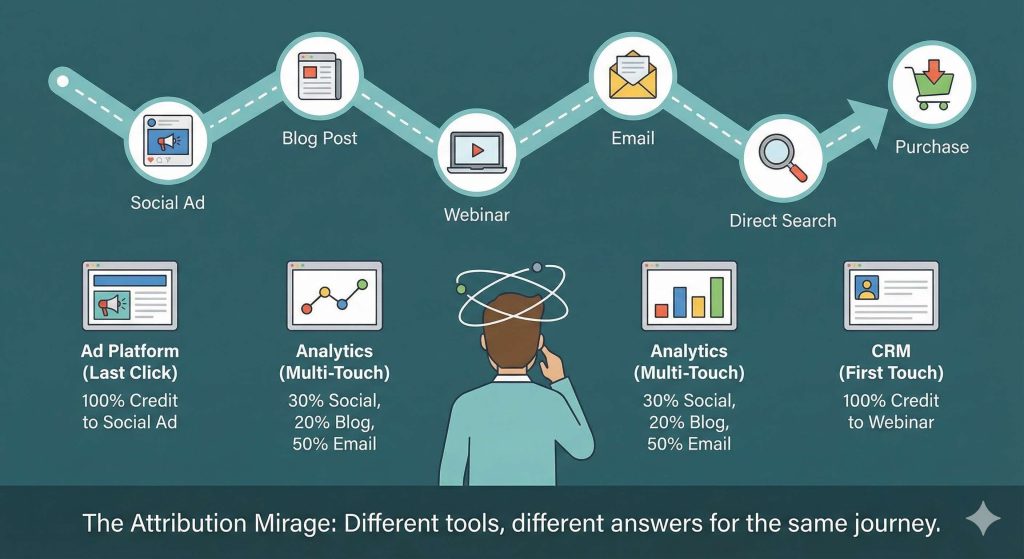
This isn’t because the tools are broken. It’s because customer behavior is messy.
Buyers don’t move in straight lines. They hesitate. They compare. They revisit. They seek reassurance. Especially in considered purchases like healthcare, B2B software, or high-value e-commerce, decisions are emotional long before they’re transactional.
Attribution tools attempt to impose logic on behavior that isn’t logical. When teams take these outputs too literally, they end up optimizing for what is measurable rather than refining their marketing analytics strategy.
How Tool Overload Slows High-Growth Teams
Speed is one of the most underappreciated advantages in marketing.
High-performing organizations don’t always have better ideas. They make decisions faster, test sooner, and adjust earlier. Tool overload quietly erodes this advantage.
Each additional platform adds interpretation overhead. Metrics must be aligned. Definitions must be reconciled. Reports must be explained. By the time consensus is reached, the market has moved.
What’s worse, decision ownership becomes unclear. When everyone has data, no one feels accountable for judgment.
Insight doesn’t just inform decisions. It empowers them. When insight is diluted, so is ownership.
Why Leadership Eventually Tunes Marketing Out
When data becomes inconsistent, leadership trust erodes.
Executives don’t expect perfect measurement. They expect coherence. When numbers change depending on the source, confidence drops. Marketing updates become noise rather than guidance.
This is how marketing teams lose their strategic seat at the table.
Not because performance is poor, but because the story isn’t credible.
Without insight, marketing becomes tactical. Tactical functions don’t drive strategy. They execute it.
Insight Is a Design Problem, Not a Data Problem
The most effective teams approach insight differently.
They don’t start with tools.
They start with decisions.
To fix their marketing analytics strategy, they ask simple but powerful questions:
What signals genuinely influence confidence?
What decisions must we make monthly?
What choices impact revenue most?
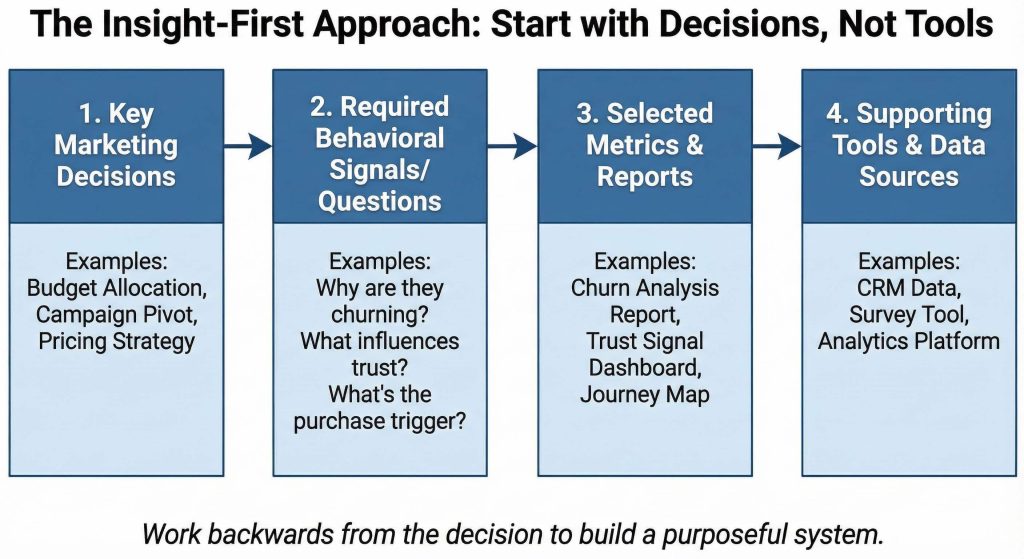
From there, they work backwards. Metrics are selected intentionally. Reports are built to answer specific questions. Tools are evaluated based on how well they support reasoning, not how many features they offer.
Insight becomes a system, not an accident.
What High-Insight Organizations Do Differently
Across industries, the organizations with the clearest marketing insight share a few traits.
They define metrics once and enforce consistency.
They limit dashboards to what executives actually use.
They prioritize behavioral signals over vanity metrics.
They accept uncertainty instead of hiding it.
Most importantly, they treat insight as an organizational capability, not a reporting task.
This shift sounds subtle. In practice, it’s transformative.
Real-World Patterns Across Industries
In SaaS, we see teams tracking dozens of funnel metrics but struggling to explain churn behavior. In healthcare, clinics measure leads but fail to understand patient trust signals. In e-commerce, brands optimize conversion rates while missing why customers hesitate at checkout.
Different industries. Same underlying issue.
Tools measure outcomes. Insight explains causes.
Without the second, optimization becomes blind.
Rebuilding Insight Without Burning the Stack
This isn’t about deleting tools. It’s about redefining their roles.
Most organizations don’t need fewer tools. They need fewer interpretations.
A practical starting point is audit-by-decision. For each major marketing decision, identify:
What data informs this?
Which tool provides it?
What assumptions are involved?
Anything that doesn’t support a decision becomes secondary. Often, clarity improves without removing a single platform.
The Role Northstone Insights Plays
At Northstone Insights, our work rarely begins with implementation. It begins with interpretation.
We help teams move from data accumulation to decision clarity. From activity tracking to behavioral understanding. From fragmented dashboards to coherent narratives leadership can trust.
Technology matters. But thinking matters more.
The Bottom Line
Modern marketing didn’t fail because it became data-driven. It faltered because it stopped asking what the data was for.
Insight is not about visibility.
It’s about conviction.
The teams that win aren’t the ones with the most tools. They’re the ones who can explain, with confidence, why customers behave the way they do and what to do about it next. That is the ultimate goal of a successful marketing analytics strategy.
That’s the difference between marketing activity and marketing leadership.


Leave a Comment