

Introduction
Why Healthcare SEO E-E-A-T is important? Here’s a reality check: 77% of patients use search engines before booking a healthcare appointment. But here’s the catch your medical practice isn’t just competing for visibility. You’re competing for trust.
In healthcare, a single piece of misinformation can harm patients. That’s why Google scrutinizes medical websites more heavily than almost any other industry. Enter E-E-A-T: Expertise, Experience, Authoritativeness, and Trustworthiness.
If your healthcare website isn’t demonstrating these qualities, you’re not just losing rankings—you’re losing patients to competitors who do.
This guide will walk you through everything you need to know about how to optimize healthcare SEO with E-E-A-T strategies. You’ll learn actionable steps to showcase your medical expertise, build authority, earn patient trust, and ultimately rank higher while serving patients better.
TL;DR: Key Takeaways
- E-E-A-T (Expertise, Experience, Authoritativeness, Trustworthiness) is critical for healthcare SEO because medical websites are “Your Money or Your Life” (YMYL) content.
- Google’s Quality Rater Guidelines heavily scrutinize healthcare content for accuracy and credibility.
- 77% of patients research online before booking appointments—trust signals directly impact conversions.
- Core strategies include: detailed author bios, medical credentials, backlinks from authoritative sources, patient reviews, HIPAA compliance, and schema markup.
- Avoid common mistakes like thin content, missing author attribution, and ignoring technical SEO.
- The future of healthcare SEO includes AI-powered search experiences and voice search optimization.
What is E-E-A-T in Healthcare SEO?
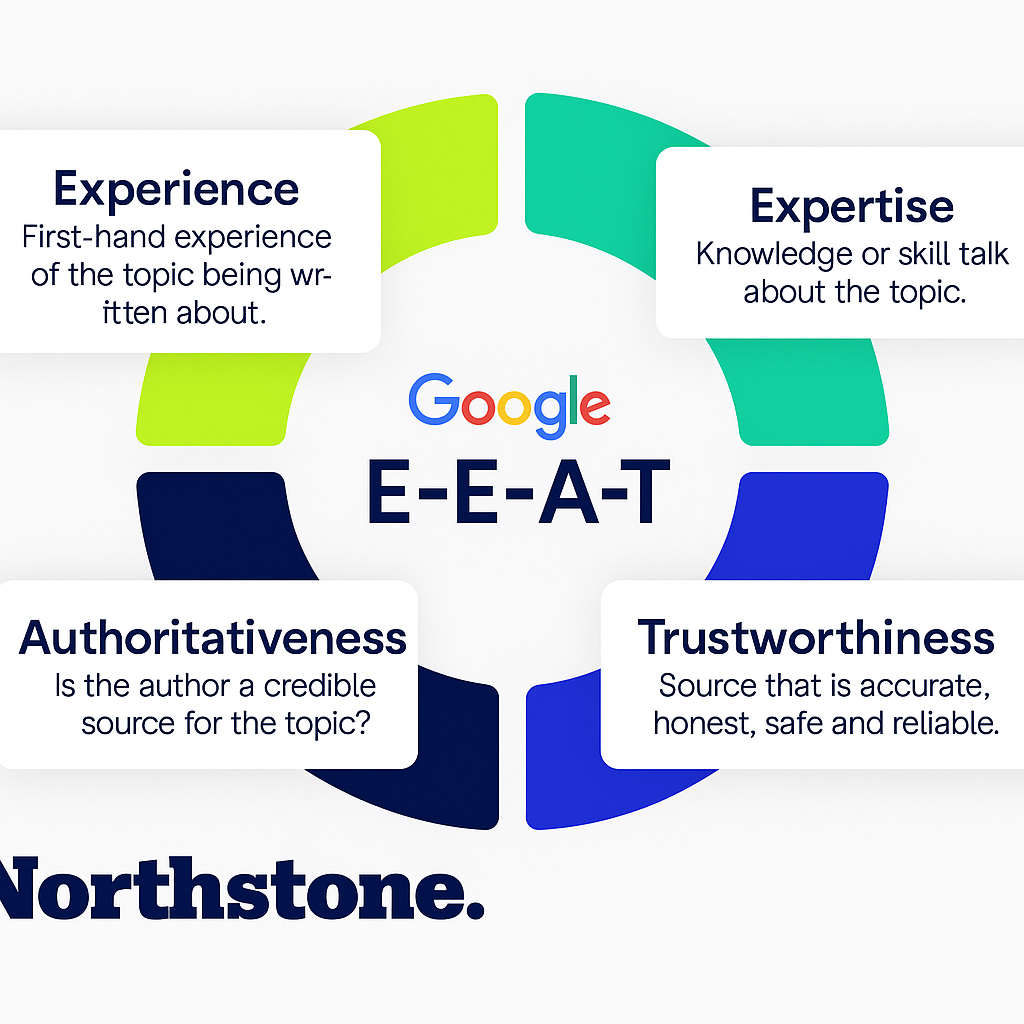
E-E-A-T stands for Expertise, Experience, Authoritativeness, and Trustworthiness. Google added the extra “E” (Experience) in December 2022 to emphasize first-hand, real-world knowledge.
Here’s what each component means for healthcare:
Expertise
Does the content creator have the necessary medical qualifications? For healthcare, this means licensed physicians, certified specialists, or credentialed healthcare professionals creating or reviewing content.
Experience
Has the author practiced medicine or worked directly with patients? Real-world clinical experience adds depth and credibility that theoretical knowledge alone cannot provide.
Authoritativeness
Is your practice recognized as a leader in your medical specialty? This includes citations from other medical websites, mentions in health publications, and presence in trusted medical directories.
Trustworthiness
Can patients trust your website with their health information and personal data? This encompasses HIPAA compliance, secure connections (HTTPS), transparent policies, and accurate, evidence-based content.
Why Healthcare is Held to Higher Standards
Healthcare websites fall under Google’s “Your Money or Your Life” (YMYL) category. These are pages that could potentially impact a person’s health, safety, or financial well-being.
Google’s Quality Rater Guidelines state that YMYL pages require “a very high level of E-E-A-T.” A poorly-optimized medical article could mislead patients, delay treatment, or cause harm—which is why healthcare SEO E-E-A-T requirements are more stringent than for other industries.
Why E-E-A-T Matters for Healthcare Practices
The Trust Factor
84% of patients say online reviews are as important as personal recommendations when choosing a healthcare provider. Your digital presence isn’t just about SEO—it’s about building the trust that converts searchers into patients.
Google’s Quality Rater Guidelines
Google employs thousands of quality raters who evaluate search results using the E-E-A-T framework. While raters don’t directly impact rankings, their feedback trains Google’s algorithms. Medical websites without clear E-E-A-T signals get flagged as low-quality.
Compliance and Legal Protection
Demonstrating E-E-A-T isn’t just good for SEO—it’s good practice. Showing credentials, citing sources, and maintaining HIPAA-compliant SEO practices protect your practice legally and ethically.
Competitive Advantage
Most healthcare practices still overlook E-E-A-T optimization. By implementing these strategies, you’re not just meeting Google’s standards—you’re outpacing competitors who aren’t.
Core Strategies to Optimize Healthcare SEO with E-E-A-T
1. Showcase Medical Expertise & Experience
The Strategy: Make credentials and qualifications impossible to miss.
Action Steps:
- Create comprehensive author bios for every content creator. Include:
- Full name and professional credentials (MD, DO, RN, PA, etc.)
- Medical school and residency information
- Board certifications and specializations
- Years of practice and patient care experience
- Professional affiliations (AMA, specialty boards, etc.)
- Add doctor author bios to every blog post, article, and service page
- Use high-quality professional headshots that convey credibility
- Link to provider profile pages with expanded credentials
- Display certifications prominently on homepage and About page
Real Example: Cleveland Clinic includes detailed physician profiles with education, research publications, and patient reviews directly on content pages—reinforcing expertise at every touchpoint.
2. Build Authoritativeness Through Strategic Content
The Strategy: Position your practice as a recognized authority in your medical specialty.
Action Steps:
- Earn backlinks from authoritative healthcare sources:
- Medical journals and publications
- University medical centers
- Health organizations (.gov and .edu domains)
- Respected health news outlets
- Get listed in trusted medical directories:
- Healthgrades
- Vitals
- Zocdoc
- WebMD Physician Directory
- Insurance provider networks
- Publish thought leadership content:
- Guest posts on healthcare publications
- Research contributions or case studies
- Speaking engagements at medical conferences
- Quotes in health news articles
- Cite authoritative sources in your content (peer-reviewed journals, CDC, NIH, WHO)
Pro Tip: A single backlink from a .gov health agency or major medical university carries more weight than 100 links from low-quality directories.
3. Strengthen Trustworthiness with Compliance & Transparency
The Strategy: Demonstrate that patient privacy and data security are priorities.
Action Steps:
- Ensure HIPAA-compliant SEO practices:
- Secure forms with encryption
- HTTPS site-wide (SSL certificate)
- Privacy-focused analytics (avoid tracking patient data)
- Compliant contact forms and scheduling tools
- Display trust signals prominently:
- Privacy policy and terms of service (linked in footer)
- HIPAA compliance statement
- Transparent pricing where applicable
- Clear contact information with physical address
- Add security badges from recognized vendors (Norton, McAfee, HIPAA Seal of Compliance)
- Include clear disclaimers on medical advice content (e.g., “This content is for informational purposes only and does not constitute medical advice”)
- Show transparent “About Us” information:
- Practice history and mission
- Team photos and backgrounds
- Community involvement
Data Point: Websites with visible trust badges see up to 42% higher conversion rates in healthcare appointment bookings.
4. Leverage Real-World Experience & Patient Stories
The Strategy: Show, don’t just tell, through real clinical experience.
Action Steps:
- Share anonymized case studies (with patient consent)
- Include before-and-after examples where appropriate (e.g., dental, dermatology)
- Publish patient testimonials and success stories
- Create “day in the life” or behind-the-scenes content showcasing your practice
- Address common patient questions from your actual clinical experience
Important: Always obtain proper consent and follow HIPAA guidelines when sharing patient stories. Anonymize all identifying information.
Example Framework for Experience-Based Content:
“In my 15 years treating patients with chronic migraines, I’ve found that combining medication management with lifestyle modifications produces the best outcomes. Here’s what I typically recommend…”
This demonstrates first-hand clinical experience while providing valuable patient information.
5. Optimize Technical SEO with E-E-A-T Signals
The Strategy: Use structured data to help Google understand your expertise.
Action Steps:
- Implement schema markup:
- MedicalOrganization schema
- Physician schema with credentials
- MedicalCondition schema for condition pages
- Review schema for testimonials
- FAQPage schema for patient questions
- Optimize metadata with credentials:
- Include “MD” or relevant credentials in author bylines
- Add “Board-Certified” or specialty in title tags where relevant
- Create an XML sitemap that prioritizes high-E-E-A-T content
- Ensure fast page load speeds (Core Web Vitals matter for YMYL sites)
Technical Note: Use Google’s Rich Results Test tool to validate your structured data implementation.
Reputation & Reviews as Trust Signals
Why Online Reviews Matter for Healthcare SEO
Patient trust in online healthcare content is heavily influenced by peer reviews. Google explicitly considers reputation research as part of E-E-A-T evaluation.
Key Statistics:
- 94% of patients use online reviews to evaluate healthcare providers
- Medical practices with 4+ star ratings see 30% more appointment bookings
- Review quantity and recency both impact local SEO rankings
How Google Uses Reviews as E-E-A-T Signals
Google’s algorithms assess:
- Review ratings across multiple platforms (Google, Healthgrades, Vitals)
- Review sentiment (positive vs. negative language)
- Response rate (do you engage with patient feedback?)
- Consistency across platforms
- Credibility of review sources (verified patient reviews carry more weight)
Action Plan for Managing Online Reputation
Build Review Volume:
- Send follow-up emails requesting reviews after appointments
- Make it easy with direct links to Google Business Profile
- Train front desk staff to mention reviews during checkout
Respond to All Reviews:
- Thank patients for positive feedback
- Address negative reviews professionally and privately
- Never violate HIPAA by discussing patient details publicly
Monitor Your Reputation:
- Set up Google Alerts for your practice name
- Use reputation management tools (Birdeye, Podium, Reputation.com)
- Regularly audit all review platforms
Example Response Template:
“Thank you for taking the time to share your experience, [Patient Name]. We’re glad we could help with your [general condition]. If you have any questions about your continued care, please don’t hesitate to reach out to our office.”
Common Mistakes in Applying E-E-A-T to Healthcare SEO
Mistake #1: Thin or Generic Content
Publishing shallow articles that don’t demonstrate real medical expertise. A 300-word blog post about “What is Type 2 Diabetes?” won’t compete with comprehensive guides from Mayo Clinic.
Fix: Create in-depth, unique content that reflects your clinical experience. Aim for 1,500+ words for condition pages.
Mistake #2: Missing or Weak Author Attribution
No author bios, or generic bios without credentials and experience details.
Fix: Every piece of content should clearly show who wrote or reviewed it, with full credentials visible.
Mistake #3: Ignoring Medical Content Review
Publishing medical content without physician review or citing outdated sources.
Fix: Have licensed practitioners review all clinical content. Update articles annually and add “Last Reviewed” dates.
Mistake #4: Overlooking Technical Compliance
Not having HTTPS, missing privacy policies, or insecure patient forms.
Fix: Conduct a HIPAA compliance audit. Implement SSL, secure forms, and clear privacy documentation.
Mistake #5: Not Claiming or Optimizing Google Business Profile
Many practices don’t fully optimize their local SEO presence.
Fix: Claim your Google Business Profile, complete all information, add photos, post updates, and actively collect reviews.
Mistake #6: Copying Content from Other Medical Sources
Republishing information from WebMD or other sites without adding unique expertise.
Fix: Always add your own clinical insights, local context, and real-world examples to differentiate your content.
Future of Healthcare SEO & E-E-A-T in 2025 and Beyond
AI-Powered Search Experiences
Google’s Search Generative Experience (SGE) and AI overviews are changing how patients find health information. E-E-A-T becomes even more critical as AI systems prioritize authoritative, trustworthy sources.
What This Means:
- Content from well-credentialed authors will be featured in AI-generated summaries
- Practices with strong E-E-A-T signals will dominate AI-powered search results
- Generic content farms will be filtered out
Action: Double down on demonstrating real medical expertise and first-hand experience in your content.
Voice Search and Conversational Queries
58% of consumers have used voice search to find local business information, including healthcare services.
Optimization Strategy:
- Target natural, conversational long-tail keywords
- Create FAQ content answering common patient questions
- Optimize for “near me” searches with local E-E-A-T signals
Personalization and Patient Experience
Search engines will increasingly factor in patient experience signals like:
- Time on site and engagement metrics
- Appointment booking conversion rates
- Return visitor patterns
Focus Areas:
- Improve website user experience (UX)
- Streamline online booking processes
- Create patient portals that build loyalty
Stricter YMYL Standards
Expect Google to continue tightening requirements for YMYL healthcare websites. Medical misinformation remains a major concern, meaning E-E-A-T verification will become more sophisticated.
Preparation:
- Maintain meticulous citation practices
- Keep credentials and certifications current and visible
- Regularly audit content for accuracy and currency
Conclusion: Building Patient Trust Through E-E-A-T Excellence
Healthcare SEO with E-E-A-T isn’t just about ranking higher—it’s about earning the trust that turns searchers into patients and patients into advocates.
By implementing these medical SEO strategies, you’re simultaneously improving your search visibility and strengthening the credibility of your practice. You’re showing patients that you’re not just a website—you’re a team of qualified, experienced healthcare professionals who can be trusted with their most important asset: their health.
The healthcare organizations winning in organic search aren’t cutting corners. They’re investing in comprehensive E-E-A-T optimization because they understand that in medicine, trust and expertise aren’t just ranking factors they’re professional obligations.
Your Next Steps
Ready to optimize your healthcare practice for E-E-A-T? Start here:
- Audit your current E-E-A-T signals (author bios, credentials, trust indicators)
- Implement comprehensive physician profiles on your website
- Review and update your HIPAA compliance measures
- Develop a reputation management strategy for patient reviews
- Create a content calendar focused on demonstrating clinical expertise and experience
Need help implementing healthcare SEO E-E-A-T strategies? Consider conducting a comprehensive SEO audit of your medical website to identify specific opportunities for improvement. The practices that prioritize E-E-A-T today will be the ones dominating search results and patient trust tomorrow.


Leave a Comment