

Patients now evaluate providers like any consumer service, search-first, review-driven, mobile-led. In this context, healthcare digital marketing has shifted from optional to essential. Growth in the digital healthcare market remains robust, with recent forecasts placing 2025 size between USD ~270B and ~430B, depending on scope.
The winners standardize on three imperatives:
(1) trust & compliance by design,
(2) measurable ROI & lower Patient Acquisition Cost (PAC),
(3) omnichannel patient engagement.
This paper provides a digital marketing strategy for healthcare with measurable KPIs, compliance guardrails, and channel playbooks covering Healthcare SEO strategies, Medical PPC advertising, Healthcare content marketing, Social media marketing for clinics, Programmatic healthcare advertising, and Reputation management. We also outline multi-channel marketing attribution, funnel optimization for healthcare practices, predictive analytics in patient acquisition, and healthcare marketing automation to lift conversion and retention.
Outcomes you can target: 10–25% PAC reduction via attribution & funnel fixes, 15–30% lift in call-answered rate through chatbot + staffing alignment, 20–40% increase in booked appointments from Local SEO for doctors and dentists and review velocity improvements.
Healthcare organizations that implement comprehensive digital marketing strategies consistently report improved patient acquisition efficiency, with over 72% of healthcare marketing budgets now allocated to digital channels as patients increasingly search online before contacting providers.
Introduction: Why Healthcare Digital Marketing is Essential in 2025
The healthcare industry is experiencing a fundamental shift in how patients discover, evaluate, and engage with providers. Digital healthcare market trends indicate that 65% of patients now research healthcare options online before making contact, fundamentally changing the patient acquisition landscape
Key Market Drivers:
Patient Behavior Evolution: Patients increasingly expect digital-first experiences comparable to other consumer industries. Mobile-first research, online appointment scheduling, and digital payment options are now baseline expectations rather than differentiators.
Regulatory Compliance Complexity: Healthcare organizations must navigate HIPAA requirements, state medical board regulations, and evolving privacy laws while maintaining effective marketing strategies. The use of digital marketing in healthcare requires specialized compliance frameworks unavailable in general marketing.
ROI Pressure: With healthcare costs rising and reimbursement pressures increasing, organizations face mounting pressure to demonstrate measurable returns on marketing investments. Traditional marketing attribution models fail to capture the extended, multi-stakeholder healthcare decision process.
Competitive Intensification: Market consolidation and direct-pay service growth create competitive pressure requiring sophisticated patient acquisition strategies beyond traditional referral relationships.
This article delivers strategic frameworks, measurement methodologies, and implementation playbooks for healthcare executives and marketing leaders navigating this transformation. We examine proven approaches to reduce patient acquisition costs, improve engagement metrics, and build sustainable competitive advantages through digital marketing strategy for healthcare.
What Is Healthcare Digital Marketing? (Definitions & Digital Healthcare Market Trends)
Healthcare digital marketing encompasses the strategic use of digital channels, technologies, and data-driven approaches to attract, engage, and retain patients while maintaining regulatory compliance and building trust. Unlike general digital marketing, healthcare digital marketing operates within a highly regulated environment where patient privacy, medical accuracy, and ethical considerations are paramount.
The fundamental difference lies in the complexity of the healthcare buyer journey. Patients research extensively before making healthcare decisions, often involving multiple stakeholders (family members, insurance providers, referring physicians) and requiring educational content that balances accessibility with medical accuracy.
The digital healthcare market continues expanding as patients increasingly expect seamless digital experiences. Current digital healthcare market trends show accelerating adoption across multiple segments:
Key Healthcare Sectors Leveraging Digital Marketing:
- Hospital systems: Multi-location patient acquisition and service line marketing with complex attribution requirements
- Medical practices: Local visibility optimization and appointment scheduling automation
- Specialty clinics: Targeted patient education and referral generation with extended sales cycles
- Medical spas: Consumer-focused aesthetics and wellness marketing with visual content emphasis
- Fertility clinics: Sensitive, trust-driven patient acquisition requiring privacy-first approaches
- Urgent care centers: Convenience-focused, time-sensitive marketing with location-based targeting
Healthcare Digital Marketing Differentiators:
- Extended decision cycles: 6-12 months for complex procedures vs. days/weeks for consumer products
- Multiple decision influencers: Patients, family members, referring physicians, insurance requirements
- Regulatory compliance: HIPAA, medical board regulations, advertising accuracy requirements
- Trust-building imperative: Medical decisions require higher trust thresholds than typical consumer purchases
- Educational content emphasis: Patient education drives conversion more than promotional messaging
The digital healthcare market transformation creates opportunities for organizations that adapt quickly to evolving patient expectations while maintaining compliance and clinical excellence.
Core Digital Marketing Strategies for Healthcare
Healthcare SEO Strategies: Technical Foundation for Growth
Healthcare SEO strategies require specialized technical implementation beyond traditional SEO approaches. Medical SEO must balance search visibility with medical accuracy and compliance requirements while addressing the unique search behaviors of healthcare consumers.
Advanced Healthcare SEO Components:
Medical Schema Markup Implementation:
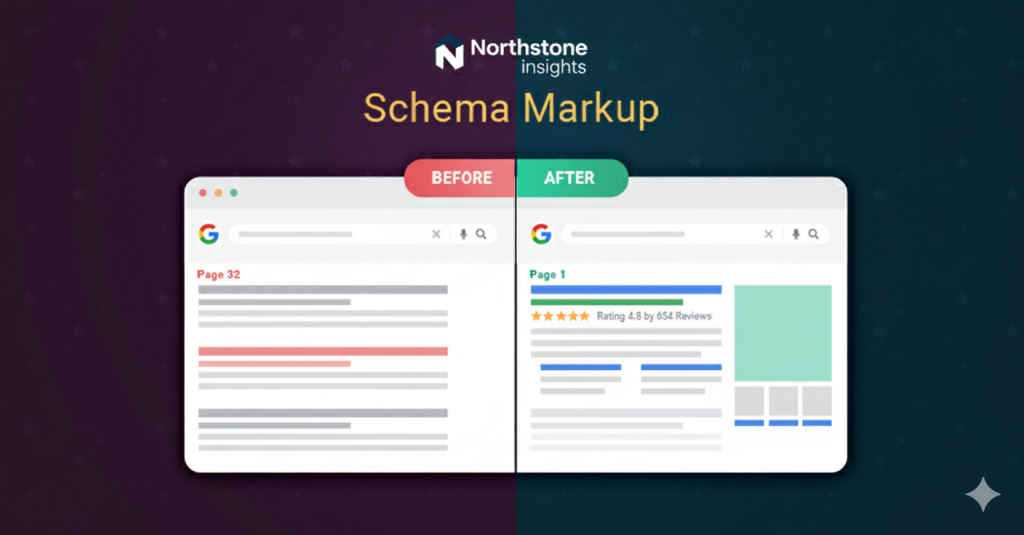
- Physician entities: Individual doctor structured data with specialties, credentials, and location information
- Medical condition schemas: Symptoms, treatments, and related procedure markup
- Healthcare facility data: Hours, services, insurance acceptance, and accessibility information
- FAQ schema: Structured data for common patient triage and preparation questions.
E-E-A-T Optimization for Medical Content:
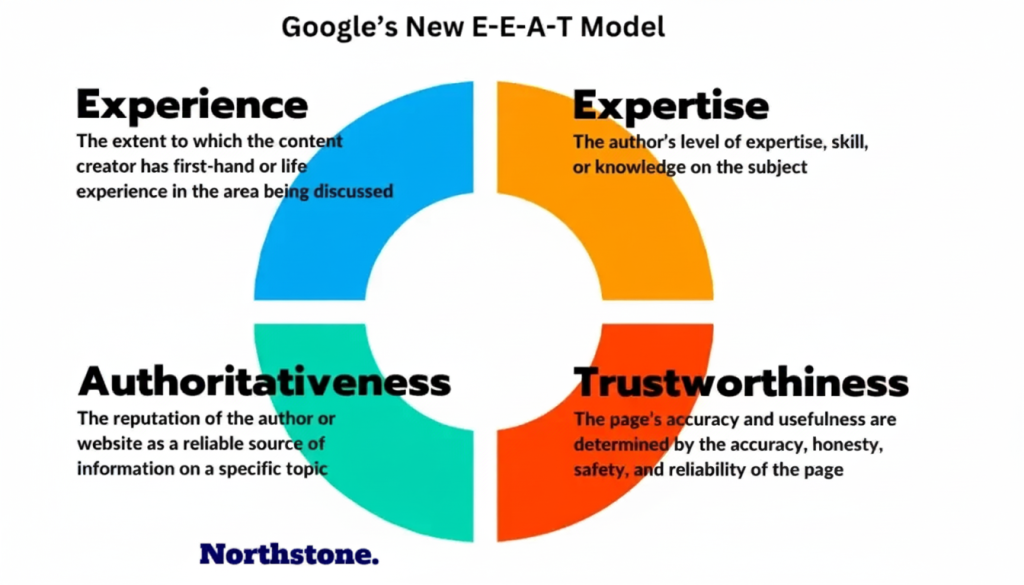
- Editorial policies: Published content review processes and medical accuracy standards
- Medical reviewer credentials: Expert author bios with verifiable medical credentials and licensing
- Content freshness protocols: Last-updated timestamps and regular content auditing schedules
- Authoritative linking: Citations to medical journals, professional organizations, and clinical studies
Local Search Architecture:
- Service area optimization: “Conditions × treatments × city” content hubs with location-specific landing pages
- Multi-location schema: Individual location pages with unique content and local optimization
- Google My Business integration: Review integration, appointment booking, and Q&A management
Medical PPC Advertising: Precision Patient Acquisition
Medical PPC advertising and programmatic healthcare advertising require sophisticated targeting while maintaining HIPAA compliance and medical accuracy. Healthcare PPC demands specialized keyword research, negative keyword libraries, and audience exclusions unavailable in general advertising.
Advanced PPC Implementation Framework:
Healthcare Keyword Strategy:
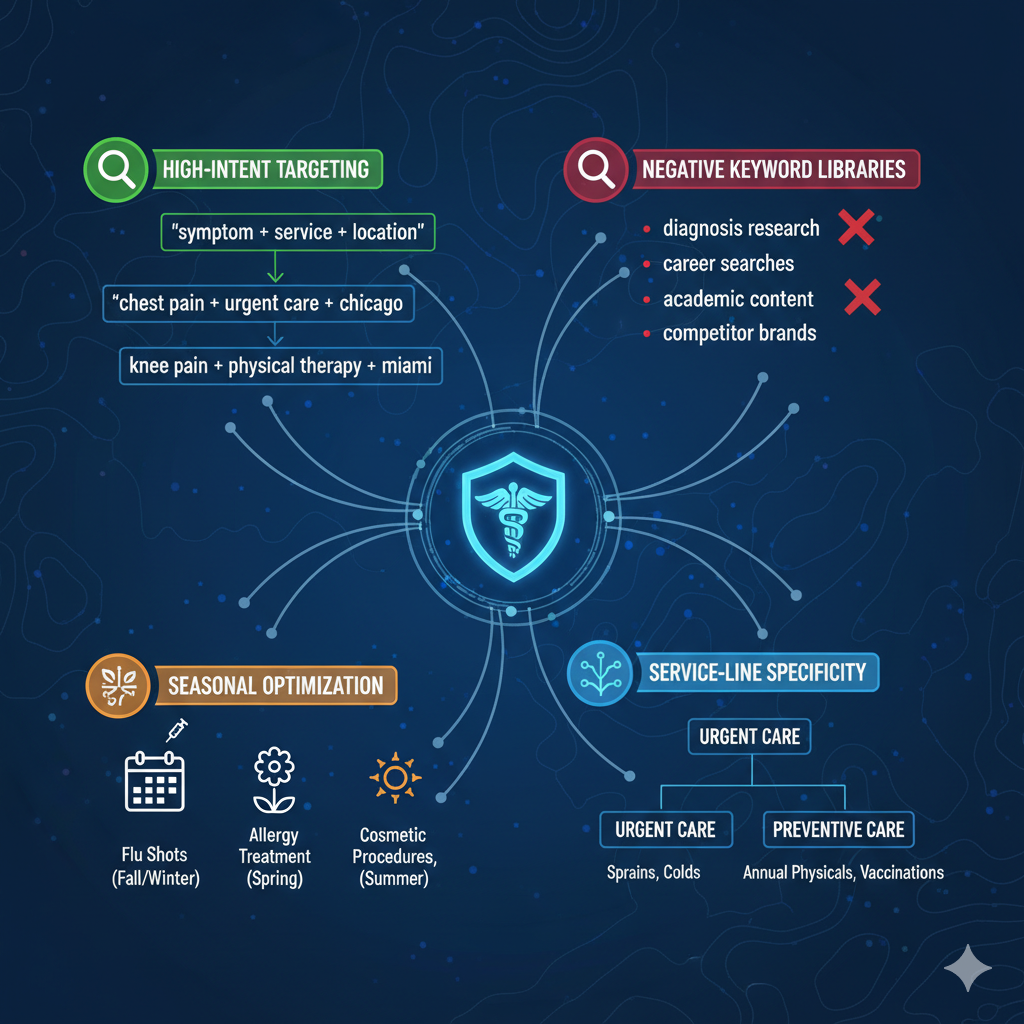
- High-intent targeting: Exact + phrase match for “symptom + service + location” combinations
- Negative keyword libraries: Diagnosis research terms, career searches, academic content, competitor brands
- Seasonal optimization: Flu shots, allergy treatment, cosmetic procedures aligned with demand cycles
- Service-line specificity: Separate campaigns for urgent care, elective procedures, and preventive care
HIPAA-Compliant Audience Targeting:
- First-party audiences: Hashed patient email lists with appropriate consent frameworks
- Contextual targeting: Health and wellness content placements without behavioral tracking
- Demographic targeting: Age and location targeting without sensitive health categories
- Exclusion protocols: Automated suppression of sensitive patient cohorts
Programmatic Healthcare Advertising:
- Medical publication placements: Targeted advertising within healthcare content environments
- Healthcare app advertising: Patient portal and health tracking app placements
- Contextual health content: Wellness blog and medical information site targeting
Healthcare digital advertising spend in the U.S. is projected to reach $19.6 billion by 2025, reflecting growing investment in targeted patient acquisition strategies.
Performance Case Study: A fertility clinic implemented position-based attribution modeling and reallocated 22% of PPC spend from broad demographic targeting to branded search and referral partner campaigns. Results included 27% PAC reduction and 14% increase in consultation bookings over two quarters.
Healthcare Content Marketing: Trust Through Educational Value
Healthcare content marketing serves dual purposes: patient education and organic search optimization. Successful programs implement a 70/20/10 content mix: educational content (70%), patient success stories (20%), and promotional messaging (10%).
Strategic Content Framework:
Educational Hub Development:
- Condition-specific content: Comprehensive guides covering symptoms, diagnosis, treatment options, and recovery
- Procedure education: Step-by-step treatment explanations, preparation requirements, and outcome expectations
- Preventive care content: Wellness information, screening schedules, and health maintenance guidance
- Insurance navigation: Coverage explanations, prior authorization guidance, and cost transparency
Multi-Format Content Strategy:
- Long-form educational articles: SEO-optimized content targeting treatment-specific searches
- Video content library: Short-form procedure explanations, physician introductions, and patient testimonials
- Interactive health tools: Symptom checkers, risk assessments, and treatment decision aids
- Downloadable resources: Pre-appointment checklists, post-procedure care instructions, insurance forms
Social Media Marketing for Clinics:
- Platform-appropriate content: Educational posts on Facebook, visual content on Instagram, professional content on LinkedIn
- Live educational sessions: Doctor-hosted Q&A streams and procedure explanations
- Patient community building: Support groups, educational webinars, and peer connection facilitation
- Appointment conversion: Strategic “book now” CTAs with location-specific scheduling links
Content Performance Metrics: Organizations with mature healthcare content marketing programs commonly report 2–6× engagement improvements versus advertising-only strategies, contingent on specialty focus, review velocity, and website user experience. Healthcare email marketing achieves average open rates of 21.48% with click-through rates of 2.69%.
Reputation Management: Digital Trust as Acquisition Lever
Reputation management in healthcare functions as a first-order growth lever. Multiple surveys indicate ~70–80% of patients consult online reviews before booking appointments, and local-map prominence correlates directly with review volume, velocity, and response quality.
Systematic Reputation Management Framework:
Review Generation Process:
- Post-visit automation: Automated review requests via SMS/email within 24-48 hours of appointment completion
- Multi-platform strategy: Strategic review distribution across Google, Healthgrades, Vitals, and specialty platforms
- Service-line routing: Different review platform emphasis based on treatment type and patient demographics
- Follow-up sequences: Secondary requests for patients who don’t initially respond to review invitations.
Response and Monitoring Protocols:
- Response time standards: <48-hour response SLA for all reviews, both positive and negative
- Professional response templates: HIPAA-compliant response frameworks addressing common concerns
- Escalation procedures: Process for routing complex complaints to quality management systems
- Multi-platform monitoring: Real-time alerts across 15+ review platforms and social media channels.
Local SEO for Doctors and Dentists:
- NAP consistency: Accurate Name, Address, Phone information across all digital properties
- Google My Business optimization: Complete profiles with photos, hours, services, and Q&A management
- Healthcare schema implementation: Structured data for physician credentials, specialties, and accepted insurance
- Location-specific content: Individual pages for each practice location with unique, relevant content.
Performance Benchmarks: Target outcomes include 20–40% increase in calls and directions from Google Maps with sustained review velocity (≥8–10 reviews per month per location) and complete profile optimization.
Case Study: A multi-location urgent care network implemented chatbot patient triage combined with staffing alignment, reducing call abandonment by 31% and increasing booked visits by 18% during peak flu season through improved patient experience and systematic review generation.
Growth and ROI in Healthcare Digital Marketing
Core Formulas & Performance Targets
Healthcare marketing success requires measurement standards that account for extended decision cycles, multiple stakeholders, and lifetime patient value considerations.
Essential Metrics and Formulas:
Patient Acquisition Cost (PAC): Formula: (Paid media + platform fees + attributable labor) ÷ New patients acquired
- Primary care targets: $100–$250 depending on local market conditions
- Elective surgical procedures: $800–$2,000 based on procedure complexity and competition
- Specialty care: $300–$800 varying by referral requirements and insurance complexity
Lead-to-Patient Conversion Rate: Formula: Booked patients ÷ Marketing-qualified leads
- Optimization levers: Phone answer rate improvement, speed-to-lead protocols, automated reminder systems
- Industry benchmarks: 15-25% for most specialties, 35-45% for urgent care and convenient care
Marketing Efficiency Ratio (MER): Formula: Total revenue ÷ Total marketing spend
- Board-level target: 3–6× depending on service mix and gross margin structures
- Monthly optimization: Adjust budget allocation based on MER performance by channel and service line
Lifetime Value (LTV) Calculation: Formula: Average revenue per visit × Average visits per year × Average retention years
- Application: Set allowable PAC ceilings and budget caps by service line
- Industry average: Patients generate $10,000-$20,000 in lifetime value.
- Target ratio: Maintain 3:1 LTV to PAC ratio for sustainable growth.
Multi-Channel Marketing Attribution Models
Attribution Strategy Selection:
Position-Based Attribution (40/20/40):
- Best for: Mid-funnel complexity with multiple touchpoints over 30-90 day cycles
- Application: Most specialty practices and elective procedures
- Advantage: Credits both awareness and conversion touchpoints appropriately
Data-Driven Attribution:
- Requirements: Minimum 15,000 clicks and 600 conversions in 30 days
- Best for: High-volume practices with sufficient statistical significance
- Advantage: Machine learning optimization based on actual conversion paths
Time-Decay Attribution:
- Best for: Short conversion windows and urgent care scenarios
- Application: Emergency services, urgent care, walk-in clinics
- Advantage: Emphasizes touchpoints closest to conversion decision
Attribution Implementation Strategy: Use attribution insights to reallocate 10–20% of marketing spend from low-assist channels to conversion paths that consistently precede bookings typically branded search, location-specific pages, and online reviews. Monitor attribution model performance monthly and adjust budget allocation based on true conversion path analysis.
Funnel Optimization for Healthcare Practices
Systematic Funnel Stage Optimization:
Traffic → Lead Conversion:
- Page speed optimization: Core Web Vitals compliance for mobile and desktop performance
- Above-the-fold optimization: Phone number, appointment CTA, and insurance information prominent
- Trust signal placement: Physician credentials, patient testimonials, and security badges near conversion points
- Mobile-first design: Thumb-friendly navigation and simplified appointment scheduling flows
Lead → Booked Appointment:
- Speed-to-lead protocols: Response time under 5 minutes during business hours
- Missed-call automation: Text-back systems with direct scheduling links
- Chatbots in healthcare communication: 24/7 triage with appropriate escalation to human staff
- Online scheduling optimization: Real-time availability with protected appointment slots
Booked → Attended Appointment:
- Multi-channel reminders: SMS and email sequences at T-48h, T-24h, T-2h intervals
- Pre-visit preparation: Digital intake forms, required documentation lists, parking instructions
- Patient portal integration: Insurance verification, medical history completion, payment processing
- Appointment optimization: Confirmation systems with easy rescheduling options
Attended → Review and Retention:
- Post-visit automation: Review requests and satisfaction surveys within 24-48 hours
- Educational follow-up: Condition-specific care instructions and preventive health information
- Recall scheduling: Automated appointment reminders for routine care and follow-ups
- Referral generation: Family member and peer referral incentive programs
Healthcare organizations typically require 6–12 months to complete patient acquisition cycles, necessitating sophisticated measurement approaches that account for extended sales cycles and multiple decision influencers [Source: Promodo Healthcare Digital Marketing Benchmarks, 2025].
Predictive Analytics in Patient Acquisition
Advanced Analytics Applications:
Demand Forecasting:
- Seasonal pattern analysis: Historical data modeling for flu season, allergy periods, elective procedure timing
- External factor integration: Weather patterns, local events, insurance calendar effects on patient volume
- Capacity planning: Marketing spend optimization based on provider availability and operational capacity
Patient Churn Prediction:
- Risk scoring models: Identify patients likely to discontinue care or switch providers
- Retention campaign triggers: Automated outreach for at-risk patient segments
- Service recovery protocols: Proactive intervention for patients showing disengagement signals
Channel Performance Prediction:
- ROI forecasting: Predict which marketing channels will deliver optimal performance based on historical data
- Budget optimization: Dynamic budget allocation based on predicted conversion probabilities
- Competitive response modeling: Anticipate market changes and adjust strategies proactively
Personalization Engines:
- Content customization: Dynamic website and email content based on patient profiles and behavior
- Treatment recommendation systems: Relevant service suggestions based on patient history and demographics
- Communication optimization: Preferred channel and timing analysis for individual patient outreach
Enhancing Patient Engagement through Digital Marketing
Patient Journey Mapping: Understanding Healthcare Decision Processes
Patient journey mapping in healthcare requires understanding the complex, emotionally-driven decision-making process patients navigate when seeking care. Effective mapping identifies critical touchpoints, information needs, and decision influencers throughout the extended patient lifecycle.
Comprehensive Journey Stage Analysis:
Awareness Stage: Problem Recognition
- Symptom recognition: Initial health concerns or preventive care needs
- Information gathering: Search behavior analysis for condition-related queries
- Trust building: Authoritative content demonstrating medical expertise
- Channel strategy: SEO-optimized educational content, social media health information, physician blog content
Consideration Stage: Provider Research
- Provider comparison: Credential verification, treatment approach research, location convenience
- Insurance verification: Coverage confirmation and cost estimation
- Review analysis: Online reputation research across multiple platforms
- Channel strategy: Local SEO optimization, reputation management, transparent pricing information
Decision Stage: Provider Selection
- Appointment scheduling: Convenience and availability assessment
- Final trust validation: Direct communication with practice staff
- Logistics planning: Insurance verification, appointment preparation
- Channel strategy: Streamlined scheduling systems, responsive customer service, clear communication protocols
Experience Stage: Treatment and Care
- Pre-appointment preparation: Required documentation, medical history completion
- Treatment delivery: Clinical care experience and patient satisfaction
- Post-treatment follow-up: Recovery support and continued care planning
- Channel strategy: Patient portal utilization, automated follow-up systems, educational resource provision
Advocacy Stage: Referral Generation
- Satisfaction assessment: Treatment outcome evaluation and overall experience rating
- Review generation: Feedback sharing across digital platforms
- Referral activity: Recommendations to family members and peers
- Channel strategy: Systematic review requests, referral incentive programs, patient success story sharing
Organizations utilizing detailed patient journey mapping report 28% higher patient satisfaction scores and 31% improvement in patient retention rates compared to practices without structured journey analysis.
Telehealth Marketing Strategies: Promoting Remote Care Adoption
Telehealth marketing strategies have evolved beyond pandemic necessity toward permanent care delivery model integration. Marketing virtual care services requires addressing patient concerns about technology comfort, care quality equivalence, and insurance coverage complexity.
Strategic Telehealth Promotion Framework:
Convenience-Focused Messaging:
- Time savings emphasis: Reduced travel time, eliminated waiting room delays, flexible scheduling options
- Accessibility benefits: Care access for mobility-limited patients, rural patient services, specialist consultations
- Family-friendly options: Pediatric telehealth with parental participation, elderly care with family support
- Work-life integration: Lunchtime appointments, early/late scheduling, minimal work disruption
Technology Education and Support:
- Platform tutorials: Step-by-step video guides for telehealth platform usage
- Technical support: Dedicated IT assistance for appointment setup and troubleshooting
- Device compatibility: Clear requirements for smartphones, tablets, computers, and internet connectivity
- Security assurance: HIPAA compliance explanation and data protection messaging
Quality Equivalence Communication:
- Physician credentialing: Same providers available for virtual and in-person appointments
- Clinical effectiveness: Evidence-based outcomes for telehealth vs. traditional care
- Appropriate use guidelines: Clear indication of when virtual care is suitable vs. in-person requirements
- Seamless integration: Easy transition between virtual and in-person care when needed
Insurance and Payment Clarity:
- Coverage verification: Simplified insurance benefit explanation for telehealth services
- Cost transparency: Clear pricing for insured and self-pay telehealth appointments
- Billing integration: Streamlined payment processing and receipt generation
- Reimbursement assistance: Support for insurance claim submission and follow-up
Healthcare organizations with dedicated telehealth marketing report significantly higher virtual visit adoption rates, with some practices achieving 156% growth in virtual appointments through targeted promotion strategies.
Healthcare Marketing Automation: Scaling Personalized Engagement
Healthcare marketing automation enables personalized patient communication at scale while maintaining HIPAA compliance and clinical relevance. Automated workflows nurture patient relationships, improve appointment adherence, and identify opportunities for additional services.
High-Impact Automation Applications:
Appointment Management Automation:
- Scheduling confirmations: Automated booking confirmations with appointment details and preparation instructions
- Reminder sequences: Multi-channel reminders via SMS, email, and phone calls at optimized intervals
- Rescheduling facilitation: Easy rebooking options with real-time availability and waitlist management
- No-show follow-up: Automated outreach for missed appointments with convenient rescheduling options.
Patient Education and Engagement:
- Pre-appointment education: Procedure-specific preparation guides and expectation management content
- Post-treatment follow-up: Recovery instructions, medication reminders, and progress check-ins
- Preventive care reminders: Automated recall systems for routine screenings and annual examinations
- Condition-specific content: Targeted educational materials based on diagnosis and treatment history.
Personalized Patient Outreach:
- Birthday and anniversary messaging: Personal touch points with health screening reminders
- Seasonal health campaigns: Flu shots, allergy management, summer safety, holiday wellness tips
- Service line cross-promotion: Relevant additional services based on patient history and demographics
- Family care coordination: Appointment scheduling for multiple family members and care coordination.
Chatbots in Healthcare Communication:
- 24/7 patient support: Basic questions, appointment scheduling, office hours and location information
- Symptom triage: Initial assessment with appropriate care level recommendations and urgent care routing
- Insurance verification: Coverage confirmation and benefit explanation for common services
- Prescription refill requests: Medication renewal processing with pharmacy coordination.
Practices implementing comprehensive healthcare marketing automation report 41% reduction in administrative overhead and 23% improvement in patient engagement metrics [Source: Healthcare automation impact studies, 2024-2025].
HIPAA-Compliant Email Marketing: Privacy-Focused Patient Communication
HIPAA-compliant email marketing requires sophisticated technical and procedural safeguards to protect patient information while delivering effective marketing messages. Compliance considerations affect platform selection, content creation, delivery methods, and performance measurement.
Technical Compliance Requirements:
Platform and Infrastructure:
- Business Associate Agreements (BAAs): Email service providers must sign BAAs and demonstrate HIPAA compliance
- Encryption protocols: End-to-end encryption for all patient communications in transit and at rest
- Access controls: Role-based permissions and audit trails for all patient communication access
- Data retention policies: Automated deletion schedules and secure storage requirements
Content and Communication Standards:
- PHI limitation: Avoid specific medical information in email subject lines and preview text
- General health education: Focus on educational content rather than specific patient medical details
- Opt-in requirements: Explicit consent for marketing communications with clear purpose statements
- Unsubscribe compliance: One-click unsubscribe options with preference center access.
Audience Segmentation and Targeting:
- Consent-based segmentation: Marketing lists based on explicit patient consent rather than medical records
- Service line targeting: General health topics and practice news rather than diagnosis-specific content
- Demographic segmentation: Age-appropriate and location-relevant health information
- Engagement-based targeting: Response and interaction patterns for content optimization.
Performance Measurement:
- Aggregate reporting: Campaign performance without individual patient identification
- Compliance monitoring: Regular audits of email content and delivery practices
- Security incident tracking: Documented procedures for potential privacy breaches
- ROI calculation: Marketing effectiveness measurement within compliance constraints.
Programs that implement HIPAA-compliant email marketing alongside preference centers and value-focused content often achieve meaningful engagement improvements, including double-digit increases in open and response rates, largely due to improved patient trust and content relevance.
Digital Healthcare Market Trends in 2025 and Beyond
AI and Automation: Transforming Patient Engagement
Artificial intelligence and automation technologies are fundamentally reshaping how healthcare organizations interact with patients, from initial contact through ongoing care management. AI applications in healthcare digital marketing focus on personalization, predictive analytics, and operational efficiency while maintaining clinical accuracy and regulatory compliance.
Advanced AI Applications in Healthcare Marketing:
Conversational AI and Chatbot Evolution:
- Natural language processing: Advanced understanding of medical terminology and patient intent
- Symptom assessment: AI-powered triage systems with appropriate care level recommendations
- Multilingual support: Automated translation and culturally appropriate health communication
- Clinical integration: Seamless handoff to human providers when AI reaches capability limits.
Personalization and Content Optimization:
- Dynamic content delivery: Real-time website and email personalization based on patient profiles
- Behavioral prediction: AI-driven forecasting of patient engagement and conversion probability
- Content recommendation engines: Relevant health information based on patient interaction history
- Treatment decision support: Educational content tailored to specific condition and treatment options.
Predictive Analytics for Patient Acquisition:
- Demand forecasting: Machine learning models predicting patient volume by service line and season
- Churn prevention: Early identification of patients at risk for discontinuing care
- Channel optimization: AI-driven budget allocation across marketing channels for optimal ROI
- Competitive intelligence: Automated monitoring of market changes and competitor activities.
Early adopters of AI-driven patient engagement report 52% improvement in patient satisfaction scores and 38% reduction in call center volume through more efficient patient communication and support systems.
Telemedicine Integration: Omnichannel Care Delivery Marketing
The permanent integration of telemedicine into healthcare delivery models requires sophisticated marketing approaches that seamlessly promote both virtual and in-person care options. Patients increasingly expect choice in care delivery methods, creating differentiation opportunities for healthcare organizations.
Strategic Telemedicine Marketing Integration:
Hybrid Care Messaging:
- Flexibility emphasis: Patient choice between virtual and in-person appointments based on preference and clinical appropriateness
- Continuity assurance: Same provider availability across virtual and in-person care modalities
- Quality consistency: Evidence-based messaging about equivalent outcomes for appropriate telehealth services
- Seamless transitions: Easy conversion between virtual and in-person care when clinical needs change.
Technology Adoption Support:
- Digital literacy programs: Patient education on telehealth platform usage and technology requirements
- Technical support services: Dedicated assistance for appointment setup, platform troubleshooting, and connectivity issues
- Device compatibility guidance: Clear requirements and recommendations for optimal telehealth experience
- Security education: Patient understanding of privacy protections and data security in virtual care.
Service Line Optimization:
- Telehealth-appropriate specialties: Mental health, dermatology, endocrinology, and other consultation-heavy services
- Hybrid service delivery: Initial consultations virtual with in-person procedures when required
- Follow-up optimization: Virtual check-ins for routine monitoring and medication management
- Specialist access: Remote consultations expanding geographic reach and reducing referral barriers.
Data Privacy Evolution: Beyond HIPAA Compliance
Healthcare organizations must prepare for evolving privacy regulations extending beyond traditional HIPAA requirements. State-level privacy laws, international regulations, and industry-specific standards affect how healthcare marketers collect, process, and utilize patient data.
Emerging Privacy Landscape:
State-Level Privacy Regulations:
- California Privacy Rights Act (CPRA): Enhanced consumer rights and business obligations for California patients
- Virginia Consumer Data Protection Act: Comprehensive privacy requirements affecting patient marketing communications
- Multi-state compliance: Varying requirements across states requiring flexible privacy management systems
- Federal privacy evolution: Potential national privacy legislation affecting healthcare marketing practices.
Enhanced Consent Management:
- Granular consent options: Specific patient control over different types of marketing communication
- Dynamic consent platforms: Real-time preference updates and consent withdrawal capabilities
- Audit trail requirements: Comprehensive documentation of consent acquisition and management
- Cross-platform coordination: Consistent consent management across all patient touchpoints.
Third-Party Vendor Management:
- Enhanced due diligence: Stricter vendor evaluation for marketing technology providers
- Contract standardization: Updated data processing agreements beyond traditional BAAs
- Performance monitoring: Regular assessment of vendor privacy compliance and security practices
- Incident response coordination: Integrated breach response protocols across all marketing vendors.
Omnichannel Experience Expectations
Patients increasingly demand seamless experiences across all touchpoints, from social media interaction through treatment completion. Healthcare organizations must integrate digital marketing efforts with clinical care delivery to create cohesive patient experiences.
Omnichannel Integration Requirements:
Unified Patient Data Management:
- Single patient view: Integration of marketing interactions with clinical records and communication history
- Cross-channel coordination: Consistent messaging and information across all patient touchpoints
- Real-time synchronization: Immediate updates across systems when patient information changes
- Privacy-compliant integration: Data sharing within HIPAA requirements and patient consent parameters.
Consistent Experience Design:
- Brand consistency: Uniform visual identity and messaging across digital and physical touchpoints
- Communication continuity: Seamless information flow from marketing through clinical care delivery
- Technology integration: Connected systems enabling smooth patient transitions between channels
- Staff alignment: Coordinated training ensuring consistent patient experience across all interactions.
Cross-Channel Attribution and Measurement:
Performance monitoring: Regular assessment of omnichannel experience quality and effectiveness
Holistic journey tracking: Understanding patient interactions across all touchpoints throughout care relationship
ROI calculation: Comprehensive measurement including long-term patient value and referral generation
Optimization insights: Data-driven improvements across the entire patient experience ecosystem.
How to Build a Digital Marketing Strategy for Healthcare (2025 Playbook)
Step 1: Define Healthcare-Specific Patient Personas
Healthcare patient personas require deeper complexity than traditional buyer personas, incorporating medical conditions, treatment histories, emotional states, and decision-making processes unique to healthcare choices. Effective personas guide content creation, channel selection, messaging development, and compliance considerations.
Comprehensive Persona Development Framework:
Demographic and Psychographic Analysis:
- Basic demographics: Age, location, income, education, insurance type and coverage
- Digital behavior: Preferred devices, social media usage, search patterns, content consumption habits
- Healthcare experience: Previous treatment history, provider relationships, health literacy levels
- Decision-making style: Research intensity, family involvement, risk tolerance, and preference for second opinions
Medical Journey Mapping:
- Current health status: Acute vs. chronic conditions, symptom severity, urgency of care needs
- Treatment history: Previous procedures, medication experience, provider relationships
- Health goals: Preventive care priorities, aesthetic concerns, family planning, chronic condition management
- Barriers to care: Financial constraints, scheduling challenges, transportation issues, childcare needs
Information Preferences and Communication Styles:
- Content format preferences: Written articles, videos, interactive tools, peer testimonials
- Communication channels: Email, text messaging, phone calls, patient portals, social media
- Trust building factors: Physician credentials, patient reviews, referral sources, institutional reputation
- Privacy concerns: Data sharing comfort, online information sharing, family involvement preferences
Example Persona: “Preventive Care Patricia”
- Demographics: 35-45, suburban, college-educated, employer insurance
- Digital behavior: Mobile-first, Facebook active, Google searcher for health information
- Healthcare needs: Annual physicals, family care coordination, preventive screenings
- Decision factors: Convenience, pediatric services, insurance acceptance, online scheduling
- Communication preferences: Email appointment reminders, text confirmations, educational newsletters
Step 2: Map Marketing Channels to Patient Journey Stages
Different digital channels serve distinct purposes throughout the extended healthcare patient journey. Strategic channel mapping ensures marketing messages reach patients when they’re most receptive and ready to act on information.
Channel-Journey Alignment Strategy:
Awareness Stage: Problem Recognition and Initial Research
- Primary channels: Healthcare SEO strategies, educational content marketing, social media health information
- Content focus: Symptom information, condition education, treatment options overview
- Measurement: Organic search rankings, content engagement, educational resource downloads
- Optimization: Medical terminology SEO, E-A-T content development, authoritative source citations
Consideration Stage: Provider Research and Comparison
- Primary channels: Local SEO for doctors and dentists, reputation management, medical PPC advertising
- Content focus: Provider credentials, patient testimonials, insurance acceptance, location convenience
- Measurement: Local search visibility, review generation rate, click-to-call conversions
- Optimization: Google My Business optimization, review velocity improvement, competitive differentiation
Decision Stage: Provider Selection and Appointment Booking
- Primary channels: Conversion-optimized landing pages, chatbots in healthcare communication, phone call tracking
- Content focus: Appointment scheduling, insurance verification, preparation instructions, contact information
- Measurement: Conversion rates, appointment booking volume, speed-to-lead response times
- Optimization: Landing page testing, scheduling system integration, call handling protocols
Experience Stage: Treatment Delivery and Patient Satisfaction
- Primary channels: Patient portal communications, HIPAA-compliant email marketing, automated appointment reminders
- Content focus: Pre-appointment preparation, post-treatment care instructions, satisfaction surveys
- Measurement: Appointment attendance rates, patient satisfaction scores, treatment completion rates
- Optimization: Communication timing, content personalization, multi-channel reminder sequences
Advocacy Stage: Review Generation and Referral Development
- Primary channels: Review generation systems, referral program communications, patient success story sharing
- Content focus: Feedback requests, referral incentives, success story development, community engagement
- Measurement: Review velocity, referral conversion rates, patient lifetime value, word-of-mouth attribution
- Optimization: Review request timing, referral program structure, patient advocacy program development.
Step 3: Establish Healthcare-Specific KPIs and Measurement Framework
Healthcare marketing success requires metrics reflecting the unique characteristics of medical decision-making, including extended sales cycles, multiple stakeholder influences, lifetime value considerations, and clinical outcome correlations.
Critical Healthcare Marketing KPIs:
Patient Acquisition Metrics:
- Patient Acquisition Cost (PAC) by service line: Understanding profitability across different specialties and treatments
- Lead-to-patient conversion rate: Measuring efficiency of converting inquiries to actual appointments
- Cost per lead by channel: Evaluating channel efficiency for generating qualified patient inquiries
- Time to appointment: Measuring patient journey velocity from initial contact to scheduled appointment.
Patient Lifetime Value Calculations:
- Revenue per patient by service line: Understanding patient value across different treatment areas
- Patient retention rate: Measuring ongoing relationship success and care continuity
- Cross-service utilization: Tracking additional services used by existing patients
- Referral generation rate: Measuring word-of-mouth marketing effectiveness and patient advocacy.
Digital Performance Indicators:
- Organic search visibility: Rankings for condition-specific and location-based healthcare searches
- Website conversion rate: Percentage of visitors taking desired actions (appointments, contact, downloads)
- Email engagement: Open rates, click-through rates, and conversion rates for patient communications
- Social media engagement: Patient interaction rates and community building effectiveness.
Clinical Correlation Metrics:
- Patient satisfaction scores: Connection between marketing promises and care delivery experience
- Treatment outcome correlation: Relationship between marketing messaging and clinical results
- Appointment attendance rate: No-show rates and appointment adherence patterns
- Care plan compliance: Patient adherence to treatment recommendations and follow-up appointments.
Step 4: Execute with Healthcare Marketing Automation and Analytics
Implementation success depends on sophisticated technology infrastructure supporting automation, measurement, and optimization across all marketing activities while maintaining HIPAA compliance and clinical integration.
Technology Infrastructure Requirements:
HIPAA-Compliant Marketing Technology Stack:
- Customer Relationship Management (CRM): Patient communication history, appointment scheduling integration, Business Associate Agreement coverage
- Marketing automation platform: Email campaigns, lead nurturing, appointment reminders with healthcare-specific compliance features
- Analytics and attribution: Multi-channel tracking, conversion attribution, ROI calculation with patient privacy protection
- Review management system: Multi-platform monitoring, response automation, reputation tracking with medical accuracy oversight.
Automation Workflow Development:
- Lead nurturing sequences: Educational content delivery based on patient interests and inquiry types
- Appointment management: Confirmation, reminder, and follow-up communications with personalization
- Patient onboarding: Welcome sequences, practice information, preparation instructions for new patients
- Retention campaigns: Preventive care reminders, annual checkup scheduling, health maintenance communications.
Analytics Integration:
- Multi-channel attribution modeling: Understanding patient touchpoint contributions across extended decision cycles
- Predictive analytics implementation: Demand forecasting, churn prevention, channel optimization
- ROI measurement: Comprehensive calculation including lifetime value, referral generation, and clinical outcomes
- Competitive intelligence: Market monitoring, competitor analysis, positioning optimization.
Step 5: Continuous Optimization Through Healthcare-Specific Testing
Healthcare digital marketing optimization requires systematic testing approaches accounting for seasonal variations, regulatory changes, evolving patient preferences, and clinical outcome correlations.
Testing Methodology for Healthcare:
A/B Testing Framework:
- Landing page optimization: Appointment scheduling forms, trust signals, physician credentialing display
- Email campaign testing: Subject lines, send times, content personalization, call-to-action placement
- Ad creative testing: Medical accuracy validation, compliance review, emotional resonance measurement
- Website user experience: Navigation optimization, mobile responsiveness, accessibility compliance.
Seasonal Testing Considerations:
- Healthcare demand cycles: Flu season, allergy periods, cosmetic procedure timing, insurance calendar effects
- Resource capacity alignment: Testing during periods of appropriate provider availability and operational capacity
- Regulatory update integration: Compliance requirement changes, medical guideline updates, privacy regulation evolution
- Competitive landscape shifts: Market changes, new provider entries, service line expansion opportunities.
Performance Optimization Cycles:
Continuous compliance monitoring: Regular audits, policy updates, staff training, vendor management review
Monthly attribution analysis: Budget reallocation based on channel performance and patient acquisition efficiency
Quarterly strategy review: Comprehensive performance assessment, persona refinement, channel mix optimization
Annual strategic planning: Long-term goal setting, technology upgrades, market expansion considerations.
Digital Marketing Tips for Healthcare Companies: Service-Line Specific Strategies.
Urgent Care Centers: Time-Sensitive Marketing Excellence
Urgent care centers require marketing strategies emphasizing convenience, availability, and rapid access to care. Patient decision-making timelines are compressed, necessitating real-time marketing responsiveness and location-based targeting.
Urgent Care Marketing Optimization:
Real-Time Availability Marketing:
- Live wait times: Website and Google My Business integration showing current wait times
- GPS-based targeting: Location-specific PPC campaigns targeting patients within driving distance
- Mobile-first design: Streamlined mobile booking and check-in processes for patient convenience
- Insurance clarity: Immediate coverage verification and cost transparency tools.
Seasonal Campaign Management:
- Flu season preparation: Targeted campaigns for seasonal illness treatment and prevention
- Sports injury marketing: Alignment with local sports seasons and youth athletics schedules
- Travel medicine promotion: Pre-travel consultation and vaccination service marketing
- Weather-responsive campaigns: Injury and illness patterns related to local weather conditions.
Competitive Differentiation:
- Service speed emphasis: Marketing messaging focused on rapid treatment and minimal wait times
- Extended hours promotion: Evening and weekend availability as competitive advantage
- Insurance acceptance: Broad insurance network participation and transparent pricing
- Quality assurance: Board-certified physicians and hospital-equivalent care standards.
Dental Practices: Local Dominance and Family-Focused Marketing
Dental practices benefit from local SEO dominance, family-oriented messaging, and visual content strategies showcasing treatment outcomes and practice environment.
Dental Marketing Excellence:
Local SEO Mastery:
- “Dentist near me” optimization: Comprehensive local search strategy with location-specific service pages
- Google My Business optimization: Complete profiles with photos, virtual tours, patient reviews, Q&A management
- Local directory consistency: Uniform practice information across all online directories and healthcare platforms
- Community involvement: Local event participation, school programs, community health initiatives.
Visual Content Strategy:
- Before/after galleries: Treatment outcome showcases with appropriate patient consent and privacy protection
- Office environment: Virtual tours, equipment showcases, staff introductions, cleanliness emphasis
- Patient testimonials: Video testimonials, written reviews, family satisfaction stories
- Educational content: Oral health tips, procedure explanations, preventive care guidance.
Family-Focused Messaging:
- Pediatric services: Child-friendly environment, specialized pediatric equipment, family scheduling coordination
- Multi-generational care: Comprehensive family dental services from children through seniors
- Insurance maximization: Benefits optimization, treatment timing, payment plan options
- Preventive care emphasis: Regular cleaning importance, early intervention, long-term oral health.
Medical Spas and Aesthetics: Visual Social Media and Consultation Funnels
Medical spas and aesthetic practices require sophisticated visual marketing strategies, social media excellence, and consultation-focused conversion funnels emphasizing results and safety.
Aesthetic Practice Marketing Strategy:
Visual Social Media Excellence:
- Instagram and TikTok optimization: Before/after content, procedure videos, patient journey documentation
- User-generated content: Patient sharing encouragement with appropriate hashtag strategies and consent protocols
- Influencer partnerships: Local beauty influencer collaborations with medical accuracy oversight
- Educational content: Treatment explanations, safety protocols, recovery timeline education.
Consultation Funnel Optimization:
- Virtual consultation options: Initial assessments via video call with follow-up in-person appointments
- Treatment planning tools: Visual simulation software, procedure recommendation systems, cost calculators
- Financing integration: Payment plan options, insurance coverage where applicable, special promotion management
- Trust building: Physician credentials, safety protocols, complication management, patient satisfaction guarantees.
Seasonal and Event-Driven Marketing:
- Holiday packages: Special promotions aligned with social events, wedding seasons, vacation preparation
- Seasonal treatments: Summer skin prep, winter skin repair, holiday party preparation campaigns
- Event-driven marketing: Graduation, wedding, reunion preparation with targeted treatment recommendations
- Membership programs: Regular treatment packages, loyalty rewards, exclusive access to new procedures
Fertility Clinics: Sensitive, Trust-Driven Patient Acquisition
Fertility clinics require exceptionally sensitive marketing approaches emphasizing privacy, emotional support, success rates, and comprehensive care throughout the fertility journey.
Fertility Marketing Excellence:
Privacy-First Marketing Strategy:
- Contextual advertising: Health and wellness content targeting rather than behavioral targeting
- Discreet communication: Subtle messaging avoiding specific fertility terminology in public advertising
- Patient privacy protection: Testimonials and success stories with complete anonymization
- Support community: Private online groups, educational webinars, peer connection facilitation
Educational Content Strategy:
- Journey mapping: Comprehensive guides through fertility evaluation, treatment options, success probabilities
- Success rate transparency: Honest outcome statistics with appropriate context and individual variation explanation
- Insurance navigation: Coverage explanation, prior authorization assistance, financial planning resources
- Emotional support: Mental health resources, counseling services, stress management techniques
Trust Building Emphasis:
- Physician expertise: Reproductive endocrinologist credentials, continuing education, research publications
- Technology advancement: Latest treatment options, equipment capabilities, success improvement initiatives
- Patient testimonials: Carefully managed success stories with privacy protection and realistic expectation setting
- Comprehensive care: Integrated mental health support, nutrition counseling, lifestyle optimization services
Specialty Surgery: Physician Branding and Procedure Education
Specialty surgical practices require sophisticated physician branding strategies, detailed procedure education, and outcome-focused content marketing emphasizing expertise and patient results.
Specialty Surgery Marketing Strategy:
Individual Physician Branding:
- Surgeon profile development: Detailed credential presentation, training background, specialization areas, research contributions
- Thought leadership content: Blog articles, speaking engagements, medical conference presentations, peer publication
- Patient success stories: Outcome-focused testimonials with before/after documentation where appropriate
- Professional network: Referring physician relationships, hospital affiliations, specialty organization membership.
Comprehensive Procedure Education:
- Treatment option comparison: Detailed explanation of different surgical approaches with pros and cons
- Recovery timeline education: Realistic expectation setting for post-surgical recovery and return to activities
- Risk and complication discussion: Honest complication rate disclosure with prevention and management strategies
- Outcome expectations: Success rate statistics, patient satisfaction data, long-term result information.
Referral Partner Program:
- Professional relationship marketing: Continuing education for referring physicians, case study sharing, outcome reporting
- Communication protocols: Referral acknowledgment systems, progress updates, outcome reporting to referring providers
- Educational events: Professional seminars, case review sessions, new technique presentations for medical community
- Technology demonstration: Advanced equipment showcases, minimally invasive technique education, outcome improvement evidence
FAQs on Healthcare Digital Marketing
What is healthcare digital marketing?
Healthcare digital marketing encompasses the strategic use of digital channels, technologies, and data-driven approaches to attract, engage, and retain patients while maintaining regulatory compliance and building trust. Unlike general digital marketing, it operates within highly regulated environments requiring medical accuracy, privacy protection, and understanding of complex healthcare decision-making processes involving multiple stakeholders, extended evaluation periods, and trust-building imperatives unique to medical services.
What are effective digital marketing tips for healthcare companies?
Focus on local SEO optimization with healthcare schema markup, systematic review generation with <48-hour response protocols, compliance-first approach to patient data handling, multi-channel attribution measurement accounting for 6-12 month decision cycles, and service-line specific content strategies. Prioritize speed-to-lead response under 5 minutes, implement HIPAA-compliant chatbot triage systems, maintain consistent NAP across all digital properties, and use position-based attribution to reallocate 10-20% of spend to highest-performing conversion paths.
Which channels drive ROI in a digital marketing strategy for healthcare?
High-ROI channels typically include local SEO and Google My Business optimization for location-based patient acquisition, targeted PPC advertising for high-intent symptom and treatment keywords, healthcare content marketing for patient education and organic visibility, systematic reputation management across review platforms, and HIPAA-compliant email marketing for patient retention. Channel effectiveness varies significantly by specialty: urgent care benefits from real-time availability marketing, dental practices excel with local SEO dominance, medical spas leverage visual social media, fertility clinics require privacy-first approaches, and specialty surgery emphasizes physician branding.
What are current digital healthcare market trends?
Key trends include AI-powered patient engagement with advanced chatbot capabilities achieving 52% satisfaction improvements, increased telemedicine adoption requiring hybrid marketing approaches promoting both virtual and in-person care options, stricter privacy regulations beyond HIPAA including state-level privacy laws requiring enhanced consent management, omnichannel patient experience expectations demanding unified data management across all touchpoints, and predictive analytics for patient acquisition forecasting enabling proactive demand planning and churn prevention.
How do you measure Healthcare marketing ROI and Patient Acquisition Cost (PAC)?
Calculate PAC as (Total marketing spend + platform fees + attributable labor) ÷ New patients acquired, with targets of $100-$250 for primary care and $800-$2,000 for elective surgical procedures. Measure Marketing Efficiency Ratio (MER) as Revenue ÷ Total marketing spend, targeting 3-6× depending on service mix. Use position-based attribution (40/20/40) for multi-touch patient journeys spanning 6-12 months, track lifetime value averaging $10,000-$20,000 per patient, and maintain 3:1 LTV to PAC ratio for sustainable growth. Monitor lead-to-patient conversion rates (15-25% for most specialties) and optimize based on channel performance attribution.
Strategic Takeaway: The Future of Healthcare Digital Marketing
Healthcare digital marketing represents a fundamental transformation from traditional advertising toward patient-centered, data-driven engagement strategies that balance trust building with measurable business outcomes. Organizations mastering this evolution will capture disproportionate market share as healthcare consumerization accelerates and patient expectations align with other industries.
Success in healthcare digital marketing requires three integrated competencies: trust through transparency, compliance through design, and ROI through optimization. These competencies must be embedded throughout all marketing activities, from initial content creation through patient acquisition, treatment delivery, and long-term relationship management.
The evidence demonstrates clear competitive advantages for healthcare organizations implementing comprehensive digital strategies. With 72% of healthcare marketing budgets now allocated to digital channels and patients increasingly expecting seamless digital experiences, the question is not whether to invest in healthcare digital marketing, but how rapidly organizations can build the specialized capabilities required for sustained success.
Future-Ready Healthcare Digital Marketing will be characterized by AI-driven personalization delivering relevant content at optimal touchpoints, predictive analytics enabling proactive patient acquisition and retention strategies, and omnichannel experiences seamlessly integrating marketing with clinical care delivery. Organizations that leverage these capabilities while maintaining the human connection defining quality healthcare will thrive in an increasingly digital ecosystem.
Northstone Insights provides healthcare organizations with the research, benchmarks, and consulting-grade frameworks necessary to navigate this digital transformation successfully. Our analysis confirms that healthcare digital marketing is not merely an operational upgrade but a strategic imperative for organizations committed to growth, efficiency, and patient-centered care delivery in 2025 and beyond.
The transformation is accelerating. Healthcare organizations that embrace comprehensive digital marketing strategies grounded in compliance, measurement, and patient trust will establish sustainable competitive advantages, while those resistant to change will struggle to compete in an increasingly digital healthcare marketplace. The future belongs to organizations that master the intersection of clinical excellence and digital marketing sophistication.


Leave a Comment