

Introduction
The era of “traffic-first” healthcare marketing is over.
For the last 15 years, the playbook was simple. You optimized keywords. You ranked. The patient clicked. They landed on your site. They booked an appointment.
That funnel is breaking.
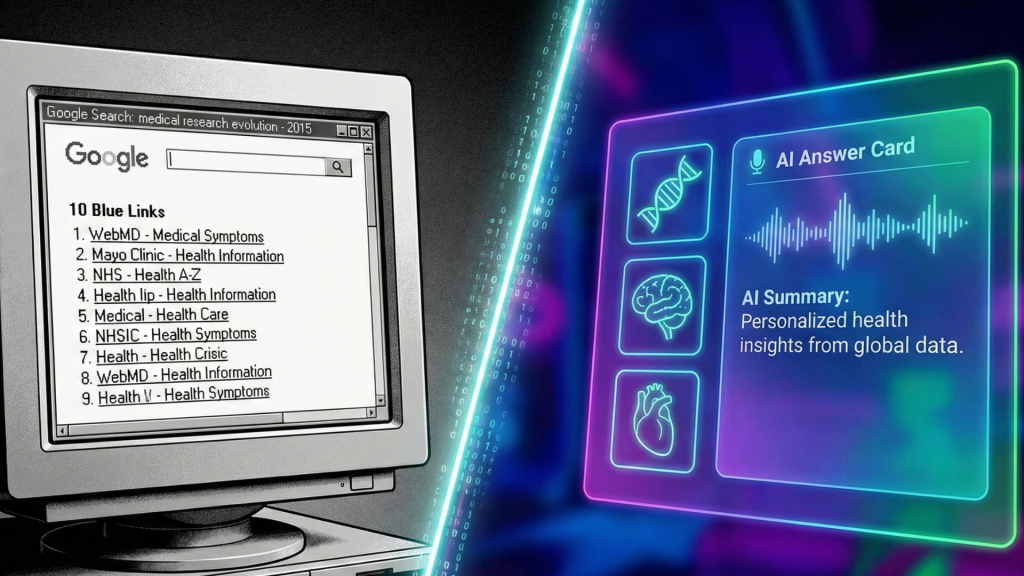
According to recent industry data, nearly 60% of mobile searches now end without a click. This is the “Zero-Click” reality.
Google’s massive shift toward ai searches powered by AI Overviews (formerly SGE) means the search engine is no longer a map. It is the destination.
When a prospective patient asks Google, “What is the recovery time for a hip replacement?” or “Best cardiologist for arrhythmia near me,” the AI is not just listing links. It is scraping content, synthesizing an answer, and presenting it directly on the results page.
If your clinic’s data is not structured to feed this AI, you are not just losing a click. You are losing the patient entirely.
In this guide, we will break down exactly how to pivot your healthcare digital strategy from SEO (Search Engine Optimization) to AEO (Answer Engine Optimization).
We will cover:
- Why the “Service Page” model is failing.
- The specific Schema markup every healthcare provider needs.
- Why your PDF pricing lists are destroying your visibility.
- The new KPIs that matter more than “Sessions.”
Chapter 1: Understanding the “Zero-Click” Threat
To fix your strategy, you must first understand the mechanism of the threat.
Traditional search engines were indexers. They cataloged libraries of websites and pointed users to the best match.
AI searches are different. They are answer engines.
When Google’s AI processes a query, it does not look for a website that contains the answer. It looks for the facts required to construct the answer itself.
The Medical Context (YMYL) This is particularly critical in healthcare, which Google classifies as “Your Money or Your Life” (YMYL). The standards for accuracy here are exponentially higher than for e-commerce or entertainment.
The AI is risk-averse. It prioritizes sources that are:
- Structured (easy to read).
- Authoritative (backed by credentials).
- Direct (no marketing fluff).
If a user asks about “symptoms of atrial fibrillation,” the AI pulls data from the Mayo Clinic, Cleveland Clinic, and other high-authority sources that have perfectly structured data.
If your local clinic has a 2,000-word blog post about AFib that is dense, unstructured, and buried in metaphors, the AI ignores it.
The result? The patient gets their answer from the search page and calls the provider listed in the “Local Pack” or the AI citation. They never visit your blog. They never see your branding.
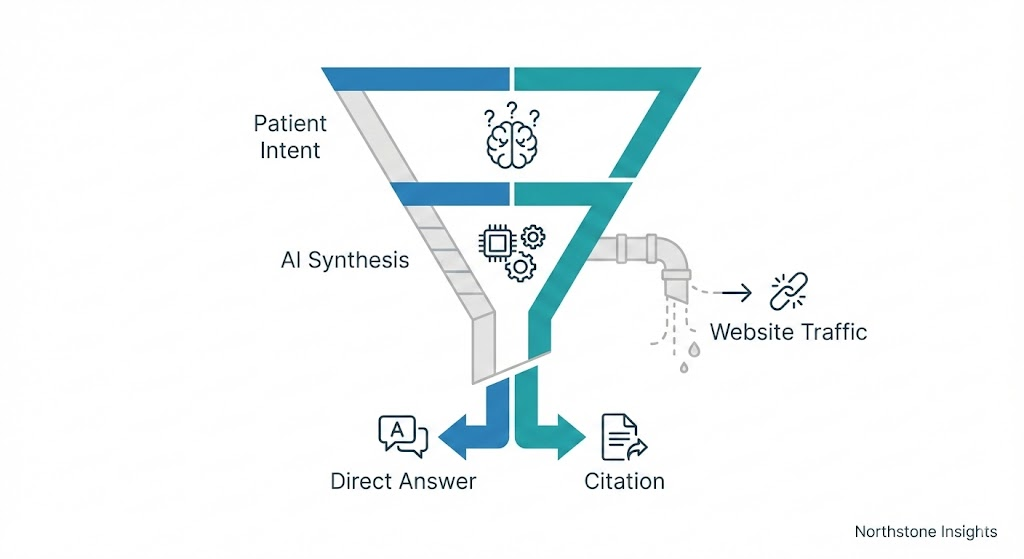
The New Funnel
- Old Funnel: Query -> Click -> Read -> Trust -> Call.
- New Funnel: Query -> Read AI Answer -> Trust AI -> Call Cited Provider.
If you are not the “Cited Provider,” you do not exist.
Chapter 2: The Shift from SEO to AEO (Answer Engine Optimization)
You are likely familiar with SEO. It is the art of ranking for keywords.
AEO is the science of ranking for answers.
While they share some DNA, the optimization tactics are fundamentally different. SEO focuses on long-form content, backlinks, and internal linking to keep people on your site. AEO focuses on concise, factual bursts of information that machines can easily ingest.
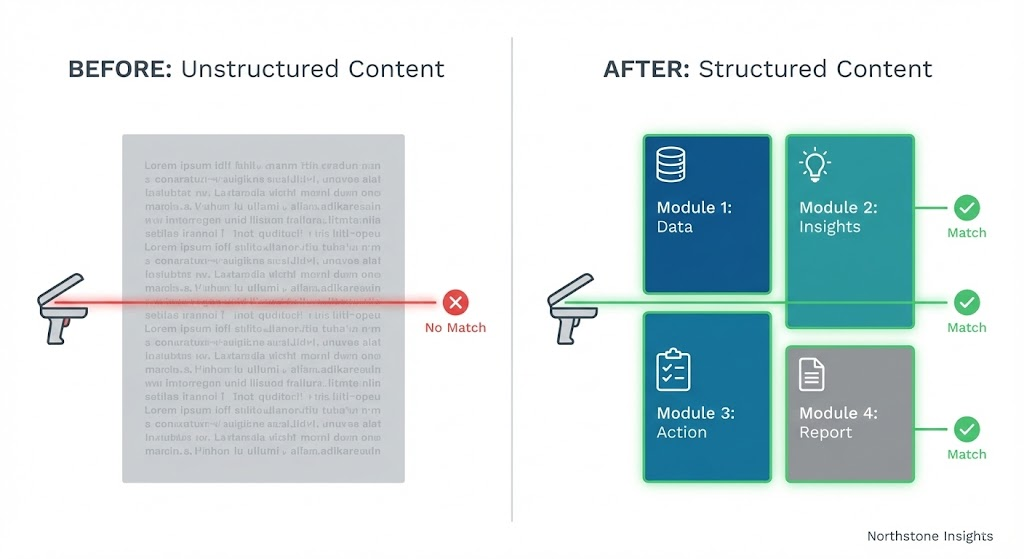
The “Inverted Pyramid” for AI Journalists use the inverted pyramid style of writing: Most important facts first, details later. AI prefers this structure too.
To optimize for ai searches, your content must provide the direct answer immediately.
Bad Structure (The Narrative Approach): “When thinking about rhinoplasty, many patients wonder about the recovery time. It is a complex process that depends on many factors. Usually, swelling goes down after a few weeks…”
Good Structure (The AEO Approach): “Rhinoplasty recovery time typically spans 6 to 12 months for full healing. However, most patients return to work within 7 to 10 days.
- Week 1: Splint removal.
- Month 1: 80% of swelling subsides.
- Month 12: Final shape refinement.”
Why This Works The second example is ready-made for an AI Overview. The AI can grab the “7 to 10 days” statistic and the bullet points and display them instantly. The first example requires the AI to “think” and parse the text, which increases the chance of hallucination or error. Therefore, the AI skips it.
Actionable Advice: Audit your top 10 traffic-driving pages. Look at the H2 headers. Immediately following the header, is there a direct, bold answer to the question? If not, rewrite it.
Chapter 3: The Technical Core – Q&A Schema Implementation
This is the most critical tactical section of this guide.
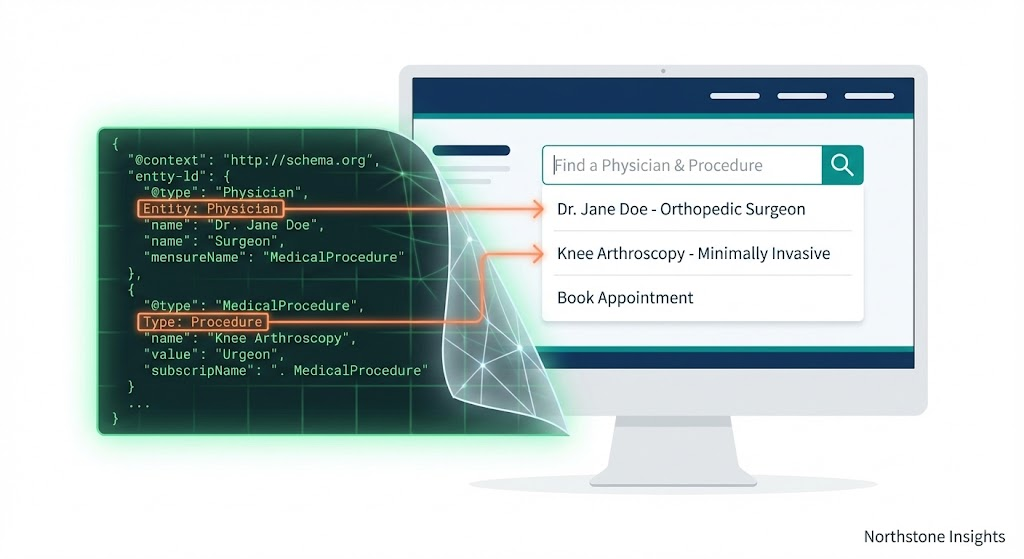
If you want to survive the death of the click, you must speak the language of the machine. That language is Schema.org (JSON-LD).
Human beings read your HTML (visual text). Robots read your Schema (code).
Why “FAQPage” Schema is Not Enough Most healthcare marketers stop at basic FAQ Schema. In 2026, that is insufficient. You need to implement specific medical schemas that define your entity and your expertise.
The “MedicalWebPage” Schema Google has specific schema libraries for healthcare. You should be wrapping your service pages in MedicalWebPage schema. Within that, you can define:
medicalSpecialty: Cardiovascular, Orthopedic, etc.procedure: The specific treatments offered.riskFactor: Potential side effects (shows objectivity).
The “Physician” Schema AI algorithms rely heavily on “Authority” (the ‘A’ in E-E-A-T). They need to know who wrote the content and why they are trusted.
Every doctor in your practice needs a bio page marked up with Physician schema that links to their:
- Medical License Number.
- Alumni/University data.
- Hospital affiliations.
- Published research citations.
The “Q&A” Schema Strategy Do not just put FAQs at the bottom of the page. Structure them.
When you use QAPage or FAQPage schema, you are explicitly telling Google: “Here is the question the user has, and here is the definitive answer.”
This significantly increases the probability of your content being pulled into the “Featured Snippet” or the AI Overview.
Northstone Insights Pro Tip: Do not guess. Use Google’s Rich Results Test tool. If your page does not validate for these specific schemas, you are invisible to the Answer Engine.
Chapter 4: The PDF Trap (And How to Fix It)
We see this mistake in 80% of the healthcare audits we conduct at Northstone Insights.
The mistake: Trapping high-value data inside PDFs.
The Scenario You have a list of “Accepted Insurance Plans.” It is a comprehensive list of 50 providers. You have a “Pricing Transparency” sheet. You have “Pre-Op Instructions.”
Where do these live? Usually, they are downloadable PDF links on a “Patient Resources” page.
Why This Kills AI Visibility While Google can technically index PDFs, they are friction-heavy.
- Mobile Unfriendly: AI prioritizes mobile-first indexing. PDFs are terrible on mobile.
- Disconnected Data: A PDF is a separate file. It does not pass “link juice” or authority back to your main domain as effectively as on-page text.
- Parsing Difficulty: AI agents scraping for quick answers struggle to extract specific rows from a PDF table accurately.
The Fix: Digitizing the Data You must ruthlessly eliminate PDFs for critical information.
- Insurance Lists: Create a searchable HTML table on your “Insurance” page.
- Pricing: Build a responsive pricing grid on the website itself.
- Forms: Use secure web-forms, not downloadable PDFs that must be printed.
When you convert a PDF pricing list into an HTML table, you suddenly allow the AI to answer the query: “Cost of MRI at [Clinic Name].”
If that data is in a PDF, the AI will likely say: “Pricing information is not readily available.”

Chapter 5: E-E-A-T and the “Experience” Factor
Google’s E-E-A-T (Experience, Expertise, Authoritativeness, Trustworthiness) framework is the governing constitution of ai searches.
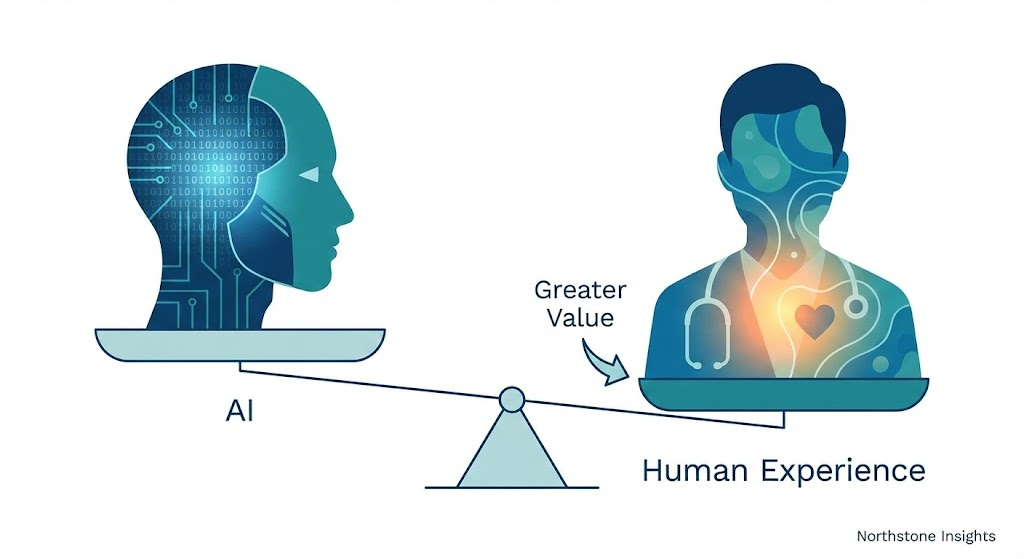
In the AI era, the new “E” (Experience) is your biggest differentiator.
AI is a summarizer. It can summarize facts found on Wikipedia or WebMD. But AI cannot have experience. It has never performed surgery. It has never comforted a patient.
Commoditized Content vs. Experience Content
- Commoditized: “What is a root canal?” (AI can answer this perfectly).
- Experience: “How I manage patient anxiety during a root canal.” (AI cannot answer this).
To win clicks in 2026, you must stop writing generic definition content. You cannot beat the AI at defining things.
Instead, produce content that highlights your specific clinical experience.
Tactical Implementation:
- Use First-Person Narratives: “In our clinic, we have found that…”
- Case Studies: “Patient X presented with these symptoms. Here is how we adjusted the standard protocol.”
- Video Integration: Embed short videos of your physicians explaining the nuance of a procedure. AI creates text; it does not yet authentically replicate a doctor’s face and voice explaining a complex diagnosis.
Google’s ranking systems are being retrained to prioritize content that demonstrates this human experience element, as it is the one thing generative AI cannot fake.
Chapter 6: New KPIs for a Post-Click World
If traffic is dying, how do you measure success?
You must educate your C-suite that “Sessions” and “Pageviews” are depreciating assets. If you optimize for AI, your traffic might drop 20%, but your patient volume could rise.
The New Scorecard
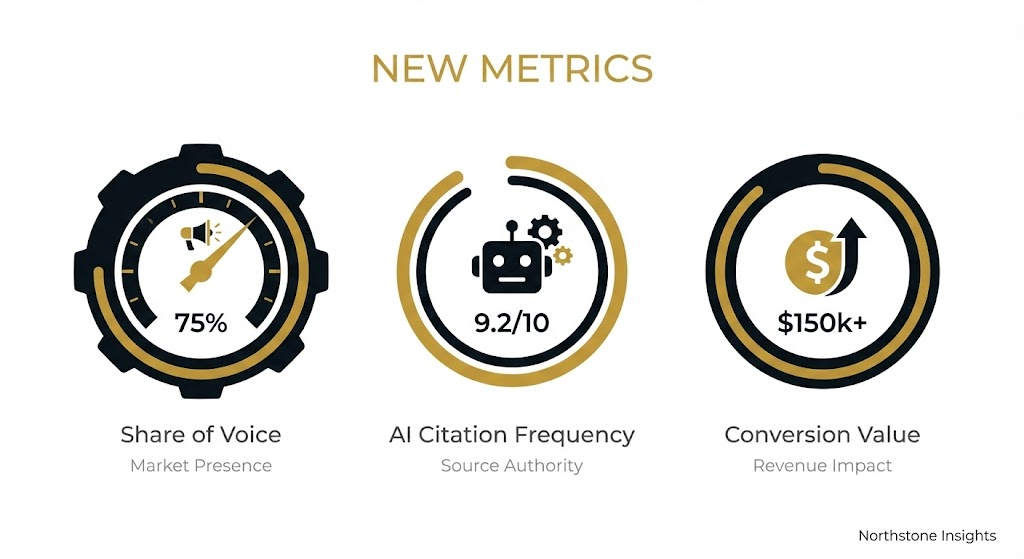
1. Share of Search (Brand Authority) How often is your brand name searched in conjunction with a medical condition?
- Good: “Knee replacement recovery.”
- Better: “[Brand Name] knee replacement recovery.”
- Why it matters: It shows users are treating you as the destination, bypassing the AI filter.
2. Answer Ownership (Rank Zero) Use rank tracking tools that monitor “Pixel Depth” or “SERP Features.” Are you the source cited in the AI Overview?
- Metric: Percentage of keywords where your URL is the citation in the generative box.
3. Down-Funnel Conversion Rate The traffic that does click through is now highly qualified. They have read the AI summary, they are informed, and they clicked anyway.
- Prediction: You will see lower traffic volume but higher conversion rates on landing pages.
- Action: Optimize your booking engine. If a user arrives from an AI answer, they are ready to book. Do not make them read another 1,000 words. Give them a “Book Now” button immediately.
Conclusion
The “Death of the Click” sounds apocalyptic, but it is actually a purification of the market.
For years, healthcare marketing was cluttered with low-quality content designed to game algorithms. AI searches are forcing a return to quality, accuracy, and technical precision.
The winners in 2026 will not be the clinics with the most blog posts. They will be the clinics with the most structured, accessible, and authoritative data.
Your roadmap is clear:
- Audit: Find where your data is trapped in PDFs or unstructured text.
- Structure: Implement aggressive Q&A and Medical Schema.
- Differentiate: Pivot content from “Definitions” to “Experience.”
The click may be dying, but the patient’s need for a trusted provider is stronger than ever. Be the answer they find.
FAQ Section
Q: If AI answers the question, why would anyone click my website? A: Users click for three reasons: Transaction (booking), Verification (checking credentials), and Nuance (deep research). AI handles the simple “What is X?” queries. Your site must serve the “I need help with X” intent.
Q: Does this strategy apply to small local clinics or just big hospitals? A: It is even more critical for local clinics. Local search is heavily influenced by AI and Maps data. If your opening hours, services, and insurance data are structured, you will dominate local voice search and AI summaries over larger, slower competitors.
Q: How long does it take for Schema changes to reflect in Google? A: Technical validation happens quickly (days), but earning the “trust” to be cited in an AI Overview can take weeks or months of consistent signaling. This is a long-term equity play, not a quick fix.
Q: Is AI content generation safe for healthcare SEO? A: Use AI to help structure content, but do not use it to write medical advice without human review. Google’s algorithms are getting better at detecting “unhelpful” auto-generated content. In YMYL fields, human review is mandatory for ranking.
Northstone Insights Advisory This analysis is part of Northstone Insights’ ongoing research into healthcare growth and strategy. Our reports combine data, strategy, and market intelligence to guide organizations toward higher ROI and authority. For tailored research, benchmarks, or strategic advisory, contact the Northstone Insights team.


Leave a Comment