
Introduction
Dental marketing has changed more in the last 3 years than in the previous decade. Clinics that once survived on word-of-mouth and walk-ins are now competing in a digital environment where patients compare, filter, and judge clinics within seconds, often while sitting on their couch with a smartphone in hand.
The uncomfortable truth most clinics don’t realises is this: patients don’t choose the “best” dentist. They choose the dentist who feels safest, most visible, most convenient, and most psychologically reassuring at the moment they decide to act.
In other words, in dental marketing, perception is reality.
From what we’ve seen working with clinics in different markets, most practices don’t actually have a marketing problem. They have a patient decision-making problem. There’s a gap between what patients worry about, what clinics think they’re communicating, and what the clinic’s website, reviews, ads, and staff behaviour actually signal. This guide exists to close that gap.
If you’re a clinic owner, practice manager, associate dentist building your own brand, or a new practice trying to break into a crowded area, this article will walk you through a complete, practical dental marketing system designed to help you:
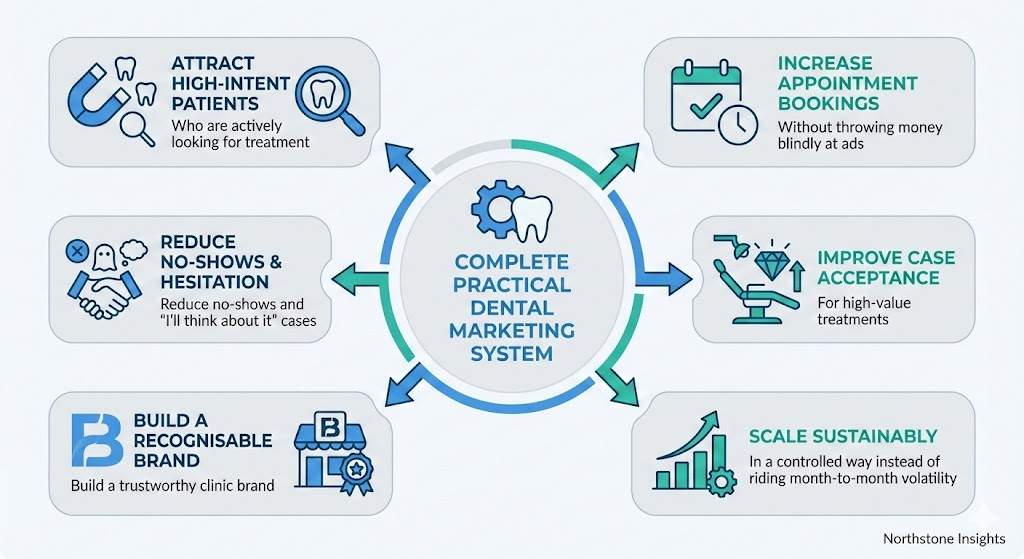
- Attract more high-intent patients who are actively looking for treatment
- Increase appointment bookings without throwing money blindly at ads
- Reduce no-shows and “I’ll think about it” cases
- Improve case acceptance for high-value treatments
- Build a recognisable, trustworthy clinic brand
- Scale in a controlled, sustainable way instead of riding month-to-month volatility
We’ll go beyond generic “post on Instagram” advice and into the real levers of dental clinic marketing: dental clinic SEO, dental PPC marketing, dental social media marketing, patient experience, and the systems that sit behind them.
Let’s start with what dental marketing actually means in 2026.
1. What Dental Marketing Really Means in 2026
Most clinics hear “dental marketing” and immediately think: Facebook page, Google Ads, a website. That’s the surface layer. The reality is that modern dental marketing is the entire system that moves a person from “I might have a problem” to “I’m sitting in your chair and paying for treatment”.
When we audit a practice, we don’t ask “What channels are you using?” first. We ask: “What has to happen for a complete stranger to trust you with their health, their money, and their fears?”
A complete dental marketing strategy in 2026 covers:
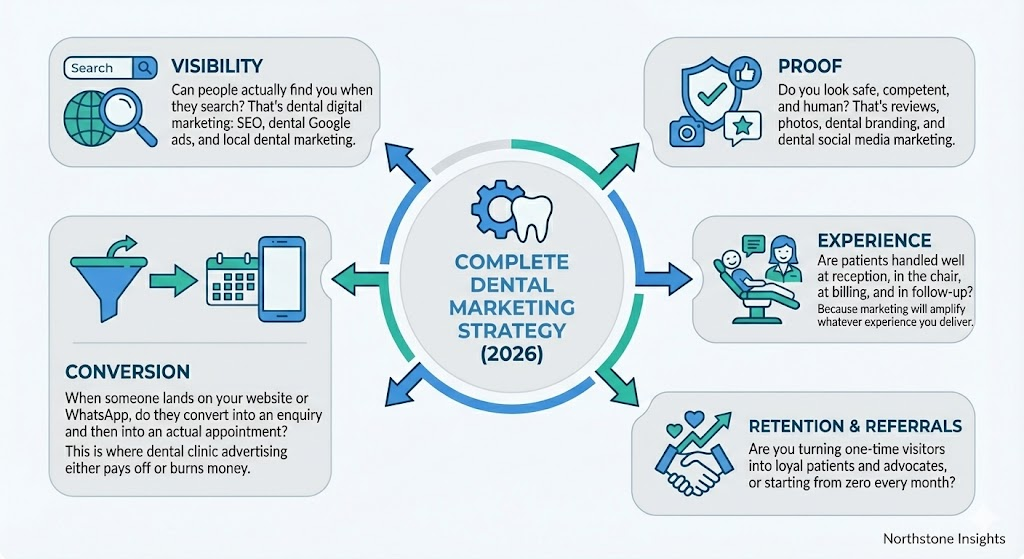
- Visibility: Can people actually find you when they search? That’s dental digital marketing: SEO, dental Google ads, and local dental marketing.
- Proof: Do you look safe, competent, and human? That’s reviews, photos, dental branding, and dental social media marketing.
- Conversion: When someone lands on your website or WhatsApp, do they convert into an enquiry and then into an actual appointment? This is where dental clinic advertising either pays off or burns money.
- Experience: Are patients handled well at reception, in the chair, at billing, and in follow-up? Because marketing will amplify whatever experience you deliver.
- Retention and referrals: Are you turning one-time visitors into loyal patients and advocates, or starting from zero every month?
Dental practice marketing is not a campaign. It’s a system tied directly to dental clinic growth and profitability. Once you see it that way, the rest of your decisions become a lot clearer.
2. The Dental Growth Engine: From Stranger To Loyal Patient
Think about your clinic like a funnel with five stages:
- They discover you.
- They evaluate you.
- They contact and book.
- They experience treatment.
- They decide whether to return and recommend you.
Most clinics obsess over stage one (more traffic, more ads) and ignore the rest. That’s why they feel stuck.
Here’s how we frame it for clients.
Discovery is where dental clinic marketing tactics like dental clinic SEO, dental PPC marketing, and dental Facebook ads live. A patient searches “emergency dentist near me” or “teeth whitening price” and runs into your website, your map listing, or your ad.
Evaluation is where dental branding and trust signals either build momentum or kill it. This is when the patient stalks your Google reviews, skims your Instagram, checks photos of your waiting area, and compares you to other options within a few kilometres.
Contact and booking is where their decision either turns into a scheduled appointment or dies in your inbox. Response time, clarity of communication, and ease of booking matter more here than any discount.
Experience is about clinical quality and emotional safety. A patient doesn’t know whether your prep margins are perfect, but they know if they felt rushed, judged, confused, or cared for. Marketing can’t fix a consistently poor experience; it will just expose it faster.
Retention and referrals are where dental marketing strategies start to compound. A practice with strong recall, smart communication, and genuine relationships spends less on acquisition because patients return with their families and refer others.
If your dental marketing doesn’t support each of these stages, you’ll always feel like you’re pushing a rock uphill, no matter how many channels you use.
3. Local Dental SEO: Becoming The Obvious Choice In Your Area
For most practices, local search is the single most important battle. When someone in your area searches “dentist near me” or “dental clinic [your neighbourhood]”, they are not browsing for fun. They’re trying to solve a problem.
If you don’t show up here, nothing else you do truly compensates for it.
3.1 Google Business Profile: Your Real Home Page
For a large percentage of patients, your Google Business Profile (GBP) is more important than your website. That’s where they see your star rating, reviews, photos, location, phone number, and opening hours at a glance.
In our experience, clinics that treat GBP as a living asset rather than a static listing generate disproportionate returns. That means:
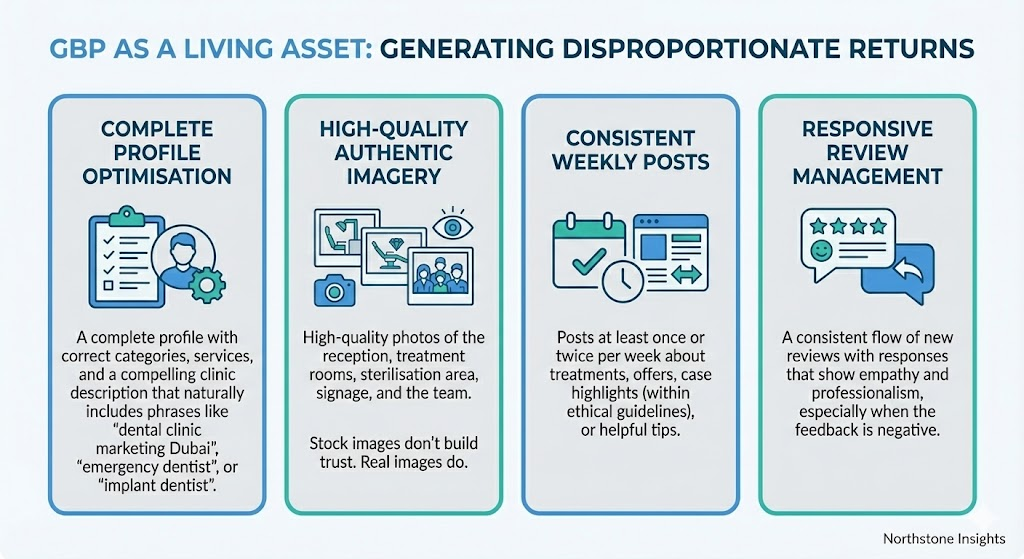
• A complete profile with correct categories, services, and a compelling clinic description that naturally includes phrases like “dental clinic marketing Dubai”, “emergency dentist”, or “implant dentist”.
• High-quality photos of the reception, treatment rooms, sterilisation area, signage, and the team. Stock images don’t build trust. Real images do.
• Posts at least once or twice per week about treatments, offers, case highlights (within ethical guidelines), or helpful tips.
• A consistent flow of new reviews with responses that show empathy and professionalism, especially when the feedback is negative.
This is the foundation of local dental marketing. A well-managed GBP often becomes the number one source of new patient calls and direction requests.
3.2 Dental Clinic SEO On Your Website
Once your map presence is solid, dental clinic SEO on your website becomes the next lever.
Strong dental SEO means:
- Each core treatment has its own page: dental implants, Invisalign, orthodontics, veneers, root canals, paediatric dentistry, gum treatments.
- Each page explains the treatment in simple language, sets expectations, addresses fears, and offers clear next steps, rather than just repeating clinical jargon.
- Your site architecture makes it easy for Google and patients to navigate: home, about, treatments, fees or finance options, contact, blog.
- You build content around high-intent queries like “how much do veneers cost”, “do I need a root canal”, “best age for braces”, “teeth whitening vs veneers”, instead of generic articles that never lead to booking decisions.
This is where many practices either never start or half-commit. But over six to twelve months, dental clinic SEO can become the difference between paying for every lead and having a steady base of free, inbound patient enquiries.
4. Dental Google Ads And PPC: Paying For Intent, Not Just Traffic
Search advertising is where dental PPC marketing shines. When a patient types “emergency dentist [city]” or “same day tooth extraction”, they’re not at the awareness stage. They’re ready.
The mistake we see repeatedly is clinics running generic dental Google ads to generic homepages. That’s like paying for people to walk into your clinic and then sending them to a locked room.
A properly structured campaign ties themes together:
- Separate campaigns for brand searches (“[Clinic Name] dentist”), core treatments (“dental implants”, “braces”, “teeth whitening”), and emergency dental.
- Ad groups that match the searcher’s intent, for example “dental implants cost”, “affordable implants”, “all-on-4 implants”, rather than mixing everything under “implants”.
- Landing pages that speak directly to the query, with treatment explainer content, approximate fees, before/after cases, testimonials, and simple booking options.
The goal of dental Google ads isn’t clicks. It’s booked appointments with the right kinds of patients.
Clinics that treat PPC as a precise acquisition tool rather than “boosting some ads” often lower their cost per lead and cost per new patient significantly within a few months. They don’t spend less; they waste less.
5. Social Media And Dentist Marketing: Building Familiarity Before Pain Strikes
Dental social media marketing is misunderstood. People assume it’s about going viral. It isn’t. Your clinic doesn’t need ten million views. It needs the right ten thousand people in your catchment area to slowly develop familiarity and trust.
That means your content should do three jobs:
First, make you human. Dentist marketing on platforms like Instagram or TikTok works when people see the faces behind the clinic: the principal dentist explaining treatments, the hygienist giving quick tips, the team celebrating small wins. Patients are deciding whether they feel comfortable sitting in your chair. Don’t hide behind stock photos and sterile posts.
Second, make treatments understandable. Educational content about implants, clear aligners, whitening, or paediatric care helps patients move from vague anxiety to informed curiosity. When dental marketing strategies include simple animations, short videos, and clear analogies, they cut through the fear and confusion.
Third, make booking feel like a natural next step. That means combining value with soft calls to action: “If you’re in [area] and thinking about Invisalign, send us a message and we’ll look at your case.” It’s subtle, but over time it drives enquiries.
The clinics that get social right don’t treat it as an isolated channel. They align it with reviews, website messaging, in-clinic experience, and broader dental practice marketing.
6. Your Website As A Conversion Engine, Not A Digital Brochure
Far too many clinics treat their website as a compliance checkbox: have a logo, list services, show a map. That might have worked in 2012. In 2026, your website is part reception, part treatment coordinator, part brand ambassador.
When a new visitor lands on your homepage, they subconsciously look for answers to questions they never articulate directly:
• Do these people look competent?
• Do they treat patients like me?
• How expensive is this likely to be?
• How soon could I be seen?
• What if something goes wrong?
A good dental marketing agency doesn’t start with colours and fonts. It starts with these questions.
A conversion-focused site:
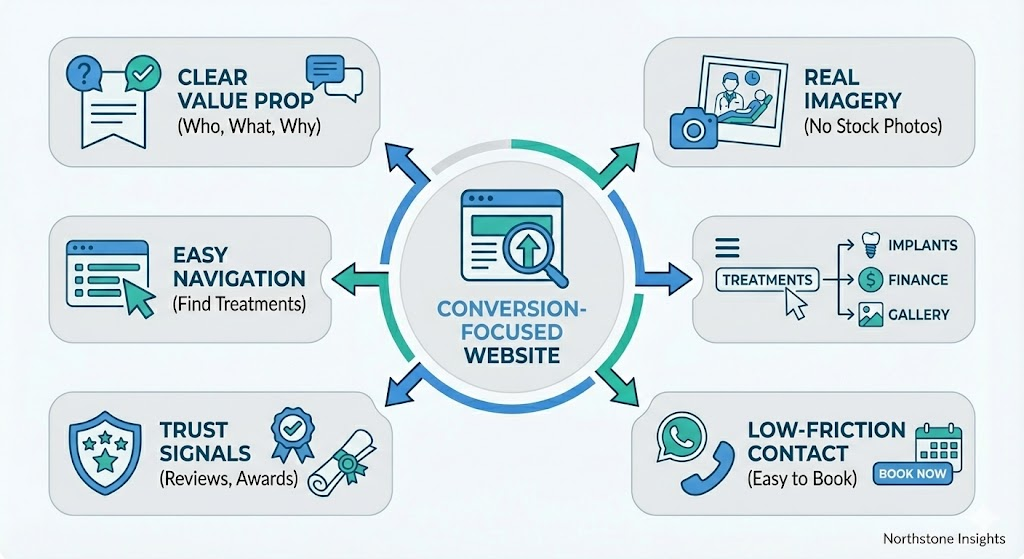
- Leads with a clear value proposition: who you help, what you specialise in, and what makes your clinic different.
- Uses real imagery from your clinic instead of generic smiling stock models.
- Highlights trust signals prominently: star ratings, review counts, professional memberships, years of experience, published case studies.
- Gives simple, low-friction options to get in touch: WhatsApp, call, online booking, enquiry forms, especially on mobile where most traffic lives.
- Makes high-value treatments easy to find via navigation and internal links. For example, from a dental implants page you might internally link to your financing options, your smile makeover gallery, and a blog article answering “Are dental implants worth it?”.
Pair this with clear, visible calls to action, and your existing traffic becomes far more valuable without increasing your ad budget.
7. Dental Lead Handling, Automation, And The Reality Of Response Time
Here’s the part that breaks more dental marketing strategies than any algorithm change or ad policy update: how fast and how well you respond to leads.
We’ve lost count of the clinics that spend on dental digital marketing, dental Facebook ads, and Google Ads, only to respond to enquiries hours or even days later. By that time, the patient has either gone to a competitor or decided to delay treatment.
In practice, what works best is brutally simple:
• Aim to respond to new leads within five minutes wherever possible.
• Use WhatsApp and SMS intelligently for quick acknowledgements and follow-up.
• Train your reception or treatment coordinator to ask the right questions without overwhelming the patient: what they need, urgency, preferred times, insurance details.
• Implement a simple but consistent follow-up sequence for patients who request prices or say “I’ll think about it”.
Dental lead generation is not just about how many people contact you; it’s about how many of them you convert into attended appointments and, from there, accepted treatment plans.
Automation should support this, not replace it. Chatbots can handle basic questions, send directions, or offer available time slots. But the emotional decision to commit to treatment still benefits from a human voice that sounds calm, confident, and empathetic.
8. Branding, Experience, And Why Patients Talk About You
Dental branding is often mistaken for logo design. In reality, it is the sum total of every experience, touchpoint, and impression a patient has with your clinic.
Brand lives in the way your team answers the phone, the ease of finding parking, the clarity of your treatment explanations, the follow-up after a difficult extraction, the tone of your reminder messages, and yes, the look of your website and reception.
From a marketing perspective, strong dental branding:
• Increases the perceived value of your treatments.
• Reduces resistance to pricing because the patient feels they’re in safe hands.
• Encourages patients to refer friends and family, because they’re proud to be associated with your clinic.
• Makes all of your advertising and social media efforts more effective, because people have mental “hooks” to remember you by.
If your dental marketing strategies are driving traffic but your Google reviews mention rude staff, long wait times, or poor communication, your brand is doing the opposite of what you’re paying for. Marketing amplifies everything, including operational flaws.
The clinics that grow steadily are usually the ones that treat branding and patient experience as non-negotiable, not as an afterthought to “getting more leads”.
9. Measuring What Matters: The Numbers Behind Dental Marketing
A serious dental marketing strategy runs on numbers, not feelings.
The goal is not to obsess over every analytic but to track the few metrics that actually reflect clinic health. In our view, these include:
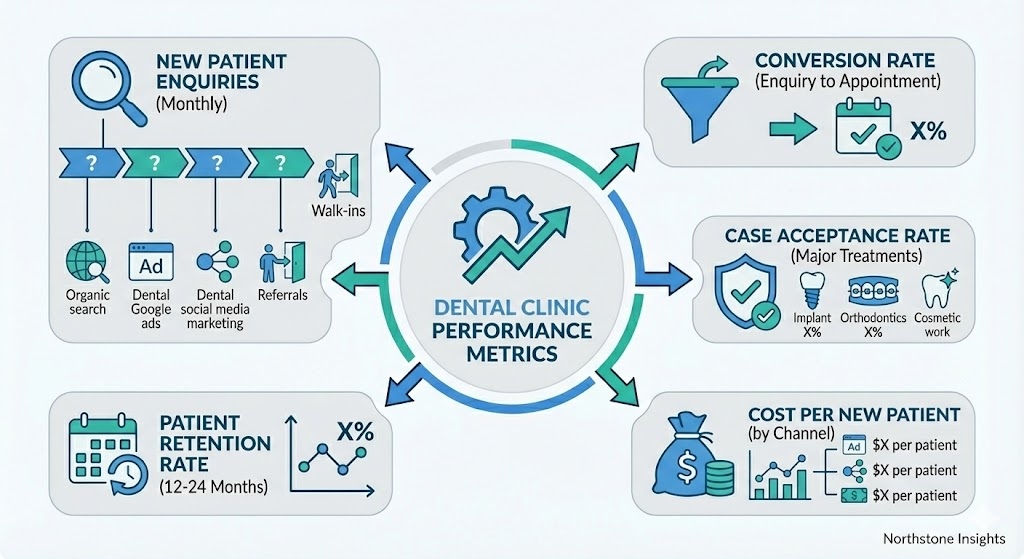
• Number of new patient enquiries per month, segmented by source: organic search, dental Google ads, dental social media marketing, referrals, walk-ins.
• Conversion rate from enquiry to attended appointment.
• Case acceptance rate for major treatments like implants, orthodontics, and cosmetic work.
• Cost per new patient by channel.
• Patient retention rate over 12–24 months.
If your dental clinic advertising produces a high volume of leads from a certain campaign but those patients rarely show up or accept treatment, the “cheap” leads may be the most expensive ones when you factor in staff time and opportunity cost.
The point of tracking is simple: shift budget and attention towards channels that bring the right kind of patients and away from channels that look good on paper but don’t translate into sustainable dental clinic growth.
10. A Practical 90-Day Dental Marketing Action Plan
All of this can feel heavy if you try to do everything at once. The clinics that make real progress typically focus on a tight 90-day window and move in layers.
In the first month, tighten your foundations. Claim and fully optimise your Google Business Profile. Clean up your website so that at least your homepage and three top treatments reflect who you really are. Start asking every satisfied patient for a review.
In the second month, invest in visibility. Launch a tightly targeted dental Google ads campaign for one or two high-value treatments that you genuinely want more of. Pair that with basic dental social media marketing that shows the human side of your clinic and answers common patient questions.
In the third month, focus on systems. Improve your lead response process. Train your team on scripts and FAQs. Implement a simple recall system for hygiene and check-ups. Start tracking where each new patient came from and what their first ticket looked like.
By the end of 90 days, you won’t have a perfect dental marketing machine. But you’ll have momentum, data, and a working structure instead of scattered tactics.
From there, you can gradually layer in more advanced dental marketing strategies: content around complex treatments, retargeting campaigns, local partnerships, community outreach, or even AI-powered appointment workflows once the basics are in place.
Summary & Next Steps
Dental marketing in 2026 isn’t about chasing every new platform or copying what the clinic down the road is doing. It’s about building a clear, patient-centred system that consistently answers three questions for the people in your area:
Can I find you when I need help?
Can I trust you with my health, time, and money?
Can I reach you easily and get seen without friction?
If your dental clinic marketing, dental clinic SEO, dental PPC marketing, dental social media marketing, and in-clinic experience all work together to answer those questions with a genuine yes, you will grow. Not overnight, not magically, but predictably.
The reality is that most clinics don’t need twenty more tactics. They need a clean strategy, better execution, and the discipline to iterate based on what the numbers and patients are actually telling them.
Start with your visibility. Fix your website. Tighten your lead handling. Build your reviews. Then add more force through well-structured campaigns and better branding.
Do that consistently and dental marketing stops feeling like a gamble and starts feeling like what it should be: an investment in the long-term health of your practice.
FAQ
How much should a dental clinic spend on marketing?
There’s no single right number, but many growing clinics allocate between five and ten percent of their monthly revenue to dental marketing. New practices in competitive areas may need to invest a bit more in the first year to gain visibility.
Is SEO or Google Ads better for dental clinics?
Both have different roles. Dental clinic SEO builds long-term, compounding visibility but takes months to fully mature. Dental Google ads can generate enquiries within days but require ongoing budget. The most stable practices usually run both in parallel, using PPC to bridge the gap while SEO grows.
Do social media followers actually matter?
Followers by themselves don’t pay the bills. What matters is whether your dental social media marketing builds familiarity and trust with people who live near your clinic. A smaller, locally relevant audience is far more useful than a large, random one.
How long before I see results from dental marketing?
If you fix fundamentals and launch focused campaigns, you can see an uplift in enquiries within 30–60 days. Meaningful, stable dental clinic growth often takes six to twelve months of consistent effort, especially when SEO and reputation management are involved.
Can a small, single-dentist clinic compete with larger chains?
Yes, but not by trying to match their budget. Smaller practices win by being more personal, faster in communication, clearer in their niche, and more authentic in their branding. Dental marketing strategies that emphasise the dentist’s expertise, relationships, and continuity of care often resonate strongly with patients who are tired of feeling like numbers in a system.
At Northstone Insights, we decode how marketing, technology, and patient behavior intersect to shape the future of healthcare growth. Our mission is to equip healthcare leaders with insights that drive measurable impact, smarter decisions, and sustainable success. To explore how we can support your growth strategy, reach out to our advisory team at Northstone Insights.

Leave a Comment