

Picture two clinics in the same affluent suburb.
Clinic A is located on a prime corner of Main Street. They pay $12,000 a month in rent for the privilege of high visibility. Approximately 5,000 cars drive by every day. Maybe 1% of those drivers are looking for a doctor right now. The rest are just commuting.
Clinic B is tucked away in a medical office building three streets over. Their rent is $4,000 a month. But when a patient in that zip code pulls out their iPhone and types “urgent care near me” or “best pediatrician,” Clinic B appears in the top slot of the Google Map Pack. They receive 5,000 intentional impressions a day from people actively seeking care.
Clinic A is paying for exposure. Clinic B is investing in intent.
In our work with healthcare groups across the country, we see this scenario play out constantly. Practice owners obsess over physical real estate, the square footage, the signage, the waiting room aesthetics. Yet, they treat their digital location with a “set it and forget it” attitude.
Here is the hard truth for 2026: Your Google Business Profile (GBP) is no longer just a directory listing. It is a commercial asset that rivals, and often exceeds, the value of your physical location.
If you want to understand the future of medical SEO, you have to stop thinking like a marketer and start thinking like a real estate investor.
Pillar 1: The “Digital Footfall” Equation
In commercial real estate, valuation is driven by footfall. How many people walk by? How many cars drive by? You pay a premium for density.
In the digital economy, we have a different metric: Digital Footfall.
The math is brutal, but it clarifies everything. Let’s look at the “Near Me” phenomenon. Since 2020, “near me” searches for health-related terms have exploded. Patients have been trained by Amazon and Uber to expect immediate, local solutions.
When we audit a practice, we look at a metric called Total Addressable Search Volume (TASV). This is the digital equivalent of counting cars on Main Street.
The Intent Gap
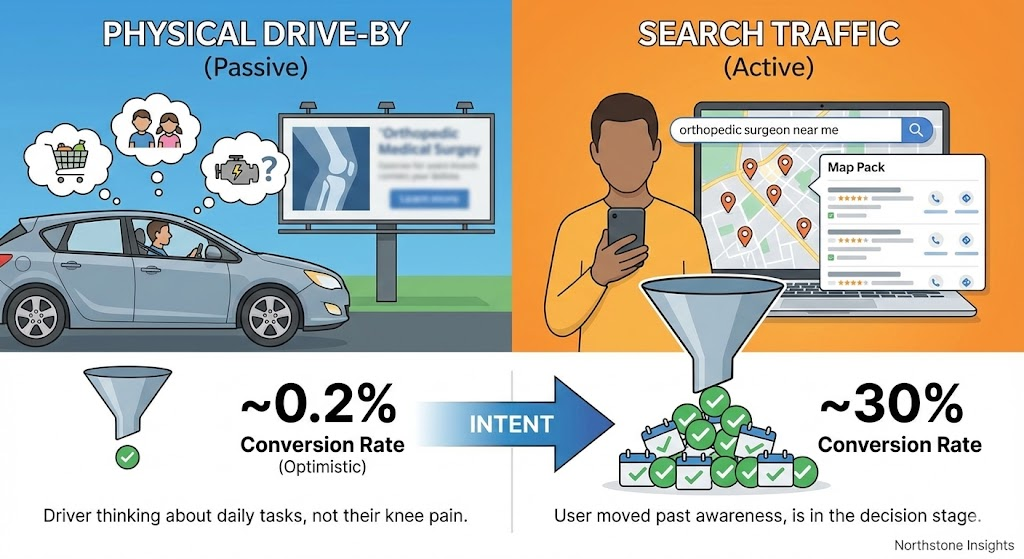
Physical traffic is passive. The driver seeing your sign is thinking about groceries, or picking up the kids, or that weird noise their engine is making. They aren’t thinking about their knee pain.
Search traffic is active. When someone types “orthopedic surgeon near me,” they have moved past the awareness stage. They are in the decision stage.
- Physical Drive-by: ~0.2% Conversion Rate (Optimistic)
- Map Pack Click: ~30% Conversion Rate
When you invest in medical SEO, you aren’t buying a billboard; you are buying a spot in the patient’s decision-making process exactly when it matters.
We’ve seen practices spend $50,000 on a lobby renovation to impress patients who already walked through the door, while refusing to spend $5,000 on the local SEO strategy required to get them there in the first place. That is a misallocation of capital.
Pillar 2: The Zero-Sum Game of the “Local Pack”
Here’s where the “Real Estate” analogy gets competitive.
On Main Street, there is room for dozens of businesses. If you are the 10th best-looking building on the block, you are still visible. You still exist.
On Google Maps, specifically the “Local Pack” (that map snippet with three business listings that appears at the top of search results), there are only three spots.
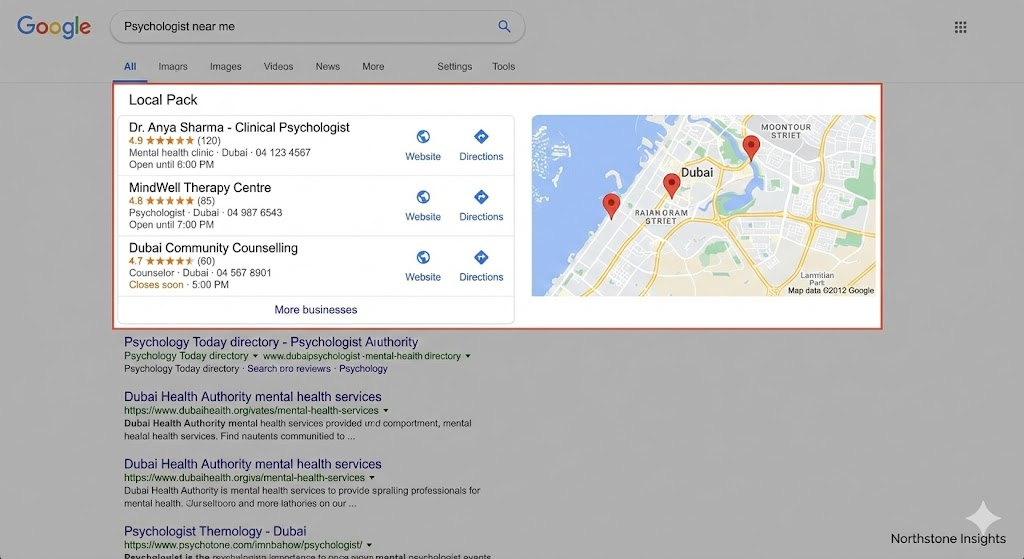
This is a zero-sum game.
- Position 1-3: Captures roughly 44-61% of all clicks.
- Position 4-10: (The “View All” abyss): Captures less than 8%.
- Position 11+: You are invisible.
In medical SEO, there is no participation trophy. You are either one of the three options presented to the patient, or you are statistically irrelevant.
Why “Good Enough” Doesn’t Rank
Many doctors tell us, “But I have a website, and I verified my Google profile.”
That’s like saying, “I have a building, and I unlocked the front door.” It’s the bare minimum for entry, not a strategy for dominance.
To break into that top 3, Google’s algorithm creates a composite score based on three vectors:
- Relevance: How well does your medical listing match the user’s specific query? (e.g., “pediatric dentist” vs. just “dentist”).
- Distance: How close is the patient to your clinic? (You can’t control this, but you can optimize for the radius).
- Prominence: This is the big one. This is where medical SEO actually happens. Prominence is a mix of your review velocity, your citation consistency across the web (Yelp, Healthgrades, Vitals), and the authority of your main website.
If you aren’t treating your ranking with the same competitive rigor as your clinical outcomes, you are handing market share to the practice down the street that is.
Pillar 3: The Valuation Impact (The Private Equity Perspective)
This is the part most agencies won’t tell you, because they don’t understand the business of healthcare.
At Northstone Insights, we often advise groups preparing for a liquidity event a sale to Private Equity (PE) or a merger with a larger hospital system.
When a PE firm values your practice, they are looking at EBITDA (Earnings Before Interest, Taxes, Depreciation, and Amortization). But they are also looking at risk and sustainability.
The “Transferable Asset” Test
Imagine two practices with identical revenue ($5M/year).
Practice A gets its patients through paid ads (PPC). They spend $30,000/month on Google Ads. Their Customer Acquisition Cost (CAC) is high. If they turn off the ads, the new patients stop coming immediately.
Practice B ranks #1 in the Local Pack for every major service line in their city. They spend $5,000/month on organic medical SEO maintenance. They get the same number of patients as Practice A, but their CAC is 80% lower.
Which practice is worth more?
Practice B is significantly more valuable. Why?
- Higher Margins: Lower marketing costs flow directly to the bottom line (EBITDA).
- Asset Transferability: A Google ranking is a digital asset. It has momentum. If the ads turn off for Practice A, revenue hits zero. If Practice B pauses effort, their ranking (and revenue) sustains for months or years.
- Goodwill & Reputation: A 4.9-star rating with 500 reviews is “digital goodwill.” It proves to the buyer that the patient base is loyal and satisfied.
We have seen local business ranking strength add meaningful multipliers to exit valuations. A robust digital presence proves to investors that you have a “moat” around your business.
The Mechanics of Trust: How to Build the Asset
So, you accept the premise. You want to own the real estate. How do you actually do it? Medical SEO in 2026 isn’t about stuffing keywords into your description. It’s about signaling Trust.
1. The Review Economy (Your Credit Score)
Reviews are not just vanity metrics; they are the currency of local search. But here is the nuance: Velocity matters more than total volume.
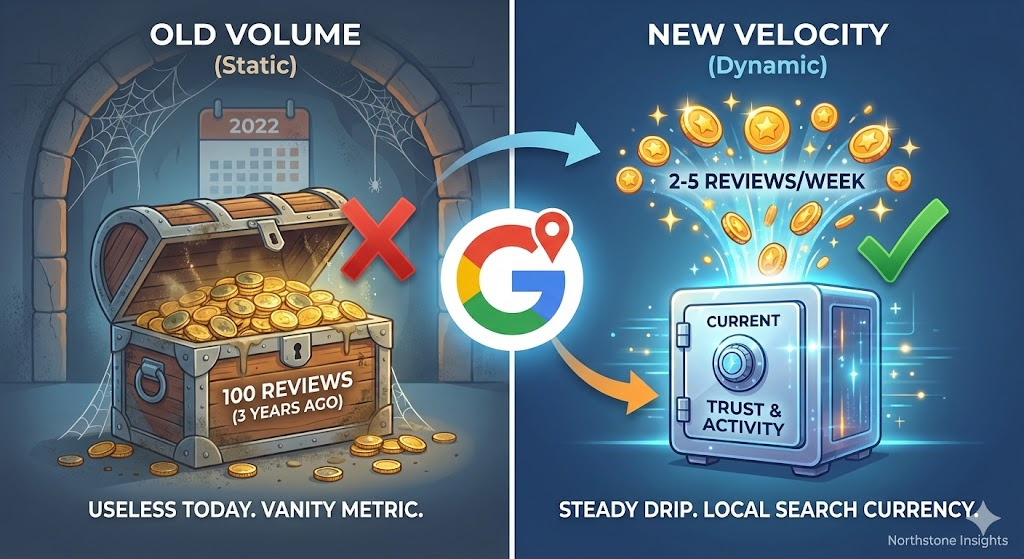
Getting 100 reviews three years ago is useless today. Google wants to see that you are currently active and trusted. You need a steady drip of 2-5 reviews per week.
- Pro Tip: Don’t just ask for a review. Ask for a review that mentions the service. “Dr. Smith fixed my torn ACL” is infinitely more powerful for SEO than “Dr. Smith is nice.”
2. N.A.P. Consistency (The Foundation)
Name, Address, Phone number. It sounds basic, but you would be shocked at how many medical groups mess this up.
- On Google: “Northstone Medical Center”
- On Healthgrades: “Northstone Medical”
- On Facebook: “Northstone Clinic”
To Google, these look like three different businesses. This dilutes your authority. You need 100% consistency across the entire ecosystem of data aggregators.
3. Localized Content Clusters
Your website needs to connect to your map profile. If you want to rank for “Dermatology in [City Name],” you need a dedicated location page on your site that talks specifically about that city. Embed a map. Mention local landmarks. Show photos of the outside of the building (to help the patient find you) and the inside (to reduce anxiety).
The 2026 Outlook: AI and SGE
We can’t talk about the future without addressing the elephant in the room: AI Search (Google’s Search Generative Experience).
Some alarmists say AI will kill local search. We believe the opposite.
When a user asks an AI, “Find me a top-rated cardiologist who accepts Blue Cross,” the AI still needs a database of truth to pull from. That database is Google Maps.

If anything, medical SEO is becoming more critical. In an AI world, the “long tail” of search disappears. The AI will likely only present the top 1-3 options with a summary. Being #4 won’t just mean less traffic; it will mean being excluded from the conversation entirely.
The practices that build their data structured, reputation-rich profiles now are the ones that will be recommended by the AI assistants of 2026.
Summary & Strategic Next Steps
The days of treating your digital profile as an afterthought are over. In 2026, your Google Maps profile is a tangible, financial asset. It reduces your reliance on paid ads, increases your practice valuation, and captures the highest-intent patients in your market.
It’s time to stop paying rent for visibility and start owning your market share.
Your Action Plan:
- Calculate your “Digital Rent”: Compare your PPC spend to your organic traffic. How much margin are you losing to ads?
- Audit the “Big 3”: Check your primary category, review velocity, and N.A.P. consistency.
- Commit to the Asset: treat medical SEO as a capital expenditure, not an operating expense.
Frequently Asked Questions (FAQ)
1. How long does it take for medical SEO to work? In our experience, “quick wins” (like fixing broken categories) can show results in 30 days. However, building the kind of domain authority that secures a top-3 map ranking typically takes 6-9 months of consistent effort. It is a marathon, not a sprint.
2. Why is my practice ranking in the city center but not the suburbs? This is the “Proximity Factor.” Google Maps prioritizes the user’s immediate location. To rank in the suburbs, you generally need location-specific pages on your website targeting those areas, or—if the volume warrants it—a physical satellite office to create a new map pin.
3. Does posting on my Google Business Profile actually help rankings? Yes, but not for the reason you think. The posts themselves don’t give you a massive ranking boost, but they signal to Google that the business is active and alive. Activity is a trust signal. We recommend posting updates (like flu shot availability or new staff announcements) at least once a week.
4. Can I just buy reviews to get my rating up? Absolutely not. Google’s fraud detection for medical SEO is incredibly sophisticated. If they catch you buying reviews (and they likely will), they won’t just remove the fake ones; they may suspend your entire profile. In healthcare, this can be catastrophic. Never risk your asset for a short-term gain.
5. How much should a medical practice budget for Local SEO? While it varies by specialty and market competitiveness (e.g., Plastic Surgery in Miami is harder than Family Med in Ohio), a healthy benchmark is 5-10% of projected revenue for marketing, with at least a third of that dedicated to organic/local infrastructure. Think of it as investing in your digital building.
At Northstone Insights, we decode how marketing, technology, and patient behavior intersect to shape the future of healthcare growth. Our mission is to equip healthcare leaders with insights that drive measurable impact, smarter decisions, and sustainable success. To explore how we can support your growth strategy, reach out to our advisory team at Northstone Insights.


Leave a Comment