

It’s the moment a marketing manager flashes a slide showing a massive spike in “impressions” or proudly declares, “We are ranking #1 for ‘Best Clinic in the City’!” The room nods. The slide deck looks green. Everyone feels good.
But then the CFO, or perhaps the Managing Director, asks the only question that actually matters:
“That’s great. But why are patient bookings flat?”
Here is the uncomfortable truth: Rankings are a vanity metric.
In the high-stakes world of healthcare growth, ranking #1 for a broad term is satisfying to the ego, but it rarely pays the overhead. If you are treating local search optimisation (or local SEO) as a game of keyword positions, you are measuring the wrong thing. You are measuring visibility, not value.
At Northstone Insights, we propose a shift in thinking. We don’t just build “rankings”; we build Search Equity.
Search Equity is the tangible, revenue-generating asset value of your organic local presence. It isn’t measured in impressions. It is measured in actions that physically bring a patient through your doors: Direction Requests and Click-to-Calls.
This framework challenges the traditional agency model. It moves away from the “Vanity Trap” and towards a rigorous, ROI-centric view of local search. Let’s break down how to calculate it, why it matters, and how to execute it.
The Vanity Trap: Why “Best Doctor” is a Losing Strategy
Let’s be honest about how patients actually search.
Many agencies will sell you on the dream of ranking for the “Head Term”—the high-volume, prestigious keywords like “Best Dentist Dubai” or “Top Cardiologist London.” These keywords have massive search volume. They look incredible on a spreadsheet.
But they often have terrible conversion rates.
Why? because the intent is too broad. A user searching for “Best Dentist” is browsing. They are window shopping. They are comparing. They might not even be in pain yet.
Contrast that with a user searching for “Emergency Root Canal near me” or “Wisdom tooth extraction cost.”
The volume for these “Procedure Keywords” is significantly lower. But the intent? The intent is transactional. This user is in pain, they have a credit card in hand, and they need a solution now.
The “Long-Tail” Revenue Model
In our analysis of healthcare search data, we’ve found a consistent inverse correlation:
- High Volume Keywords = Low Conversion Rate (The Vanity Trap)
- Specific Procedure Keywords = High Conversion Rate (The Revenue Drivers)
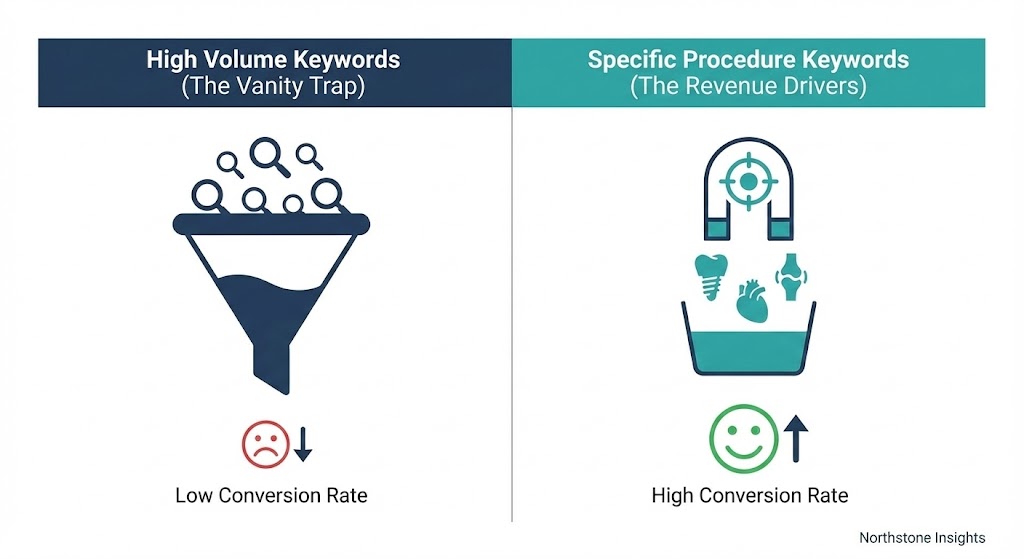
If your local search optimisation strategy focuses solely on the vanity metrics, you capture traffic that bounces. If you focus on procedure-specific local intent, you capture patients.
You don’t need more traffic. You need more qualified appointments. And in 2025, those appointments start on Google Maps, not your homepage.
The Conversion Funnel: From Maps to Revenue
Historically, the funnel looked like this:
Google Search -> Click Website Link -> Read Homepage -> Navigate to Contact Page -> Call.
That funnel is dying.
Today, for local businesses—especially in healthcare—the funnel is often “Zero-Click.” The transaction happens entirely within the Google ecosystem (Google Business Profile).
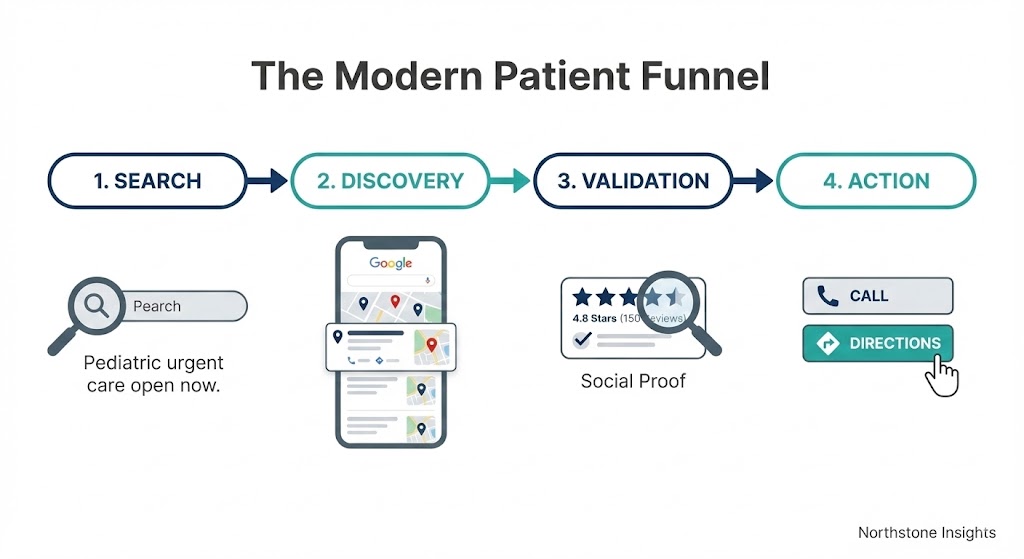
The modern funnel looks like this:
- Search: “Pediatric urgent care open now.”
- Discovery: Google Map Pack appears.
- Validation: User checks Star Rating and number of reviews (Social Proof).
- Action: User hits “Call” or “Directions” directly from the Maps interface.
They never even visited your website.
If you are relying on Google Analytics (GA4) to track your SEO success, you are missing 40% to 60% of the actual attribution. GA4 tracks website hits; it does not adequately track the patient who looked at your Map listing, drove to your clinic, and walked in.
Metrics That Actually Correlate with Revenue
To calculate Search Equity, we ignore rankings and track two specific “Conversion Actions” found in your Google Business Profile (GBP) Insights:
- Direction Requests: This is the highest-intent signal in existence. If someone asks Google for driving directions to your clinic, they are not “browsing.” They are coming.
- Click-to-Call: This is the second highest. It signifies an immediate desire to book or inquire.
These are not “soft leads.” These are revenue opportunities.
Calculating Your Search Equity
So, how do we quantify this? How do we prove to the CFO that the local search optimisation retainer is worth more than the PPC budget?
We use the Search Equity Formula.
You can calculate the potential revenue value of your local presence using this logic:
$$\text{Search Equity} = (\text{Direction Requests} + \text{Click-to-Calls}) \times \text{Conversion Rate} \times \text{LTV}$$
Where:
- Conversion Rate: The percentage of calls/walk-ins that become appointments (typically 30-50% for high-intent local leads).
- LTV (Lifetime Value): The average revenue generated by a new patient over their lifecycle.
A Real-World Example
Let’s say we are analyzing a mid-sized Orthopedic Clinic.
- Monthly Direction Requests: 150
- Monthly Click-to-Calls: 200
- Total Actions: 350
- Reception Conversion Rate: 40% (140 actual appointments)
- Patient LTV: $1,500
$$\text{Monthly Search Equity} = 350 \times 0.40 \times \$1,500 = \$210,000$$
This clinic’s local presence is generating $210,000 in revenue per month.
Now, compare that to the cost of generating those same 350 leads via Google Ads (PPC).
Benchmarks: The ROI of Organic vs. PPC
Here is the thing about PPC: It is effectively a tax on your inability to rank organically.
Don’t get us wrong, PPC is essential for immediate visibility. But it is “rented” space. As soon as you stop paying, the leads stop. Local search optimisation builds an asset that you own.
Let’s look at the cost disparity. In competitive healthcare markets (like Dental, Plastics, or Ortho), the Cost Per Click (CPC) can range from $10 to $50. The Cost Per Lead (CPL) often sits between $50 and $150.
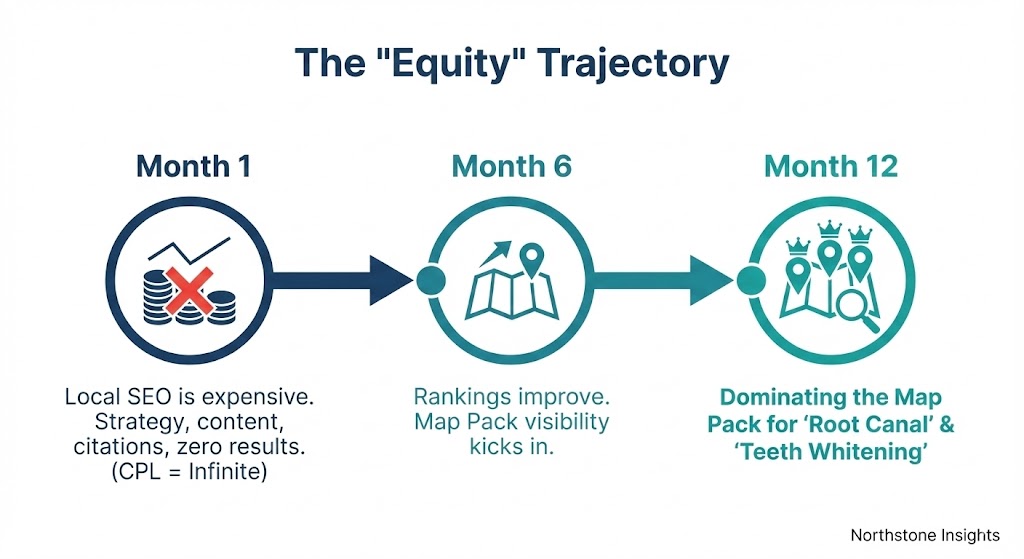
The “Equity” Trajectory:
- Month 1: Local SEO is expensive. You pay for strategy, content, and citations, but see zero results. (CPL = Infinite).
- Month 6: Rankings improve. The Map Pack visibility kicks in.
- Month 12: You are dominating the Map Pack for “Root Canal” and “Teeth Whitening.”
By Month 12, your local search optimisation retainer is fixed, but your lead volume is uncapped. Your CPL drops precipitously, often reaching 90% cheaper than paid search.
We’ve seen clinics where the PPC CPL is $120, while the Organic Local CPL drops to $12. That spread? That is your profit margin scaling.
The Pillars of Building Search Equity
If you agree that Direction Requests and Calls are the goal, how do you influence them? It’s not just about “putting keywords in the description.”
It requires a holistic, operational approach to local seo.
1. Proximity is King, but Prominence is Queen
You cannot fake proximity. If a user is 20 miles away, you likely won’t appear in the Map Pack. However, you can influence Prominence.
Google determines prominence based on how well-known and authoritative your entity is.
- Action: Build local citations on healthcare-specific directories (Healthgrades, Vitals, RateMDs).
- Action: Ensure your Name, Address, and Phone number (NAP) are identical across the web. Even a comma difference can dilute your authority.
2. The “Procedure-First” Content Strategy
Your website feeds your Map listing. If you want to rank in Maps for “Spinal Decompression,” you need a dedicated page on your site for that exact service.
- The Mistake: Having a single “Services” page with a bulleted list of 20 treatments.
- The Fix: Create a unique URL for every specific condition and treatment. domain.com/services/sciatica-treatment. Google needs a specific landing zone to connect the Map query to your business.
3. Review Velocity and Context
Stars matter, but “Review Velocity” (how often you get new reviews) and “Review Context” (what people say) matter more.
If a user searches “Compassionate pediatrician,” and three of your reviews mention the word “compassionate,” Google bolds that text in the search results. It’s a massive Click-Through Rate (CTR) booster.
💡 Pro Tip: Don’t just ask for a review. Ask for a review about the specific service.
- Bad: “Please leave us a review.”
- Good: “Could you mention how the laser treatment helped your back pain in your review?”
Implementation: Where Northstone Clients Win
In our view, the biggest barrier to local search optimisation success isn’t technical; it’s operational.
We have worked with dozens of healthcare organizations that have beautiful websites but empty waiting rooms. Why? Because their operations team and their marketing team aren’t speaking the same language.
The marketing team optimizes for “clicks.” The operations team complains about “bad leads.”
Search Equity bridges this gap.
When you report on Direction Requests, you are speaking the language of operations (“People are physically driving here”). When you report on Calls, you are speaking the language of the front desk.
A Note on “Spam Fighting”
Here is a tactic few agencies talk about: Competitor Cleanup.
Google Maps is riddled with spam. Competitors using fake names (e.g., “Best Dentist New York” instead of “Smith Dental”), using fake virtual office addresses, or stuffing keywords.
This violates Google’s guidelines.
Part of a robust local seo strategy involves monitoring your radius. If a competitor is cheating to rank above you, we flag it. We’ve seen clients jump from Position #4 to Position #2 simply by removing illegitimate listings from the map. That is “defense” turning into revenue.
Summary: The Bottom Line
If you take one thing away from this article, let it be this: Ranking reports are comfortable, but they are dangerous.
They give you a false sense of security. You can rank #1 for a term nobody searches for, and your agency will pat themselves on the back while your revenue stagnates.
To truly dominate your market, you must shift your KPI framework.
- Stop obsessing over the “Head Terms” (Vanity).
- Start obsessing over Direction Requests and Phone Calls (Equity).
- Invest in content that targets specific, high-intent procedures.
- Treat your Local SEO budget as an asset investment, not a marketing expense.
The goal of local search optimisation isn’t to be famous. It’s to be found when it matters most.
Ready to calculate your own Search Equity?
Stop guessing. Let’s look at your data, audit your local presence, and build a roadmap to domination.
FAQ: Local Search Optimization
1. How long does it take to see results from Local SEO?
In our experience, “Search Equity” is a compounding asset. You typically see movement in rankings within 3-4 months, but the significant ROI shift where the cost-per-lead drops below PPC usually happens around months 6-9. It requires patience, but the long-term payoff is ownership of your market.
2. Why is my Google Business Profile ranking different when I check from my phone?
This is due to “Proximity.” Google Maps is hyper-local. A user searching from 2 miles away will see a different set of results than someone searching from 5 miles away. We track rankings across a “grid” of locations to get an accurate average, rather than checking from a single spot.
3. Can’t I just use AI to write my location pages?
You can, but you shouldn’t rely on it 100%. Google is getting better at detecting generic, low-value content. For healthcare specifically, Google requires E-E-A-T (Experience, Expertise, Authoritativeness, Trustworthiness). Generic AI content rarely demonstrates clinical expertise. It needs human review and localized nuance.
4. Does posting on my Google Business Profile actually help rankings?
Directly? Minimally. Indirectly? Absolutely. Google Posts expire after 6 months, but they increase engagement (clicks) on your profile. Google watches behavioral signals if users are clicking your posts, viewing your photos, and reading your Q&A, Google views your entity as “active” and valuable, which supports your rankings.
At Northstone Insights, we decode how marketing, technology, and patient behavior intersect to shape the future of healthcare growth. Our mission is to equip healthcare leaders with insights that drive measurable impact, smarter decisions, and sustainable success. To explore how we can support your growth strategy, reach out to our advisory team at Northstone Insights.


Leave a Comment